Staging Environment Telemetry Versus Production Reality
Staging catches obvious bugs but misses the edge cases that only appear at production scale.
Staging exists to catch problems before real users do. It fails at that job more often than engineering teams admit, not from negligence but from a structural mismatch: staging and production are different environments by design, and the differences are exactly where the dangerous bugs hide.
A feature clears staging because the test data happens to be shaped in a way that avoids the edge case that will break in week two of production. A performance regression stays invisible because staging runs at a sliver of production's traffic volume, so the queue never backs up and the connection pool never exhausts. A third-party integration checks out clean because the staging API key points to a sandbox with different rate limits and different error behavior than the live service will ever show. None of this is a staff failure. It's what happens when a rehearsal space is asked to predict a live show it was never built to match.
Naming makes it worse. One team's "staging" is another team's production replica, and without documented entry criteria, exit criteria, and a written list of known differences, the environment manufactures false confidence instead of removing it. Cost pressure pushes in the same direction: staging environments get downsized or left half-maintained for budget reasons, and that's the same underpowering that keeps them from ever surfacing the problems that matter. CI passing and staging turning green are necessary signals. They are not sufficient. Production telemetry is the only ground truth engineering teams actually have.
The six specific ways staging telemetry diverges from production signals
Scale is the first and most obvious gap. Production infrastructure is built to absorb real traffic volume with redundancy built in; staging usually isn't, so failure modes tied to load, queue buildup, resource saturation, and connection pool exhaustion occur only under production-scale demand and are absent in a test environment running at a fraction of real demand. Latency numbers pulled from staging are artifacts of low concurrency.
Configuration drift is quieter but just as damaging. Cache settings, logging levels, thread pool sizes, feature flag states: these should vary by environment through controlled inputs, not by someone editing application code by hand, but in practice the drift accumulates without anyone noticing. A metric that looks perfectly healthy in staging might be reading off a subsystem that's configured nothing like its production counterpart.
Then there's the mismatch between staging and production interfaces. Staging environments run on mocked services, disabled notification pipelines, sandbox payment processors. Large stretches of the actual code path never get exercised until the code is live. Monitoring itself tends to be thinner in staging too, so the very telemetry rules a team leans on in production were never validated in the place changes were actually tested. Alerts tuned against staging behavior end up miscalibrated the moment they meet real traffic.
Job scheduling adds another blind spot. Cron tasks and background workers run on different cadences in staging, so anything tied to timing, concurrency, or volume thresholds slips through untested. And dashboards, even good ones, often show CPU, memory, and request rate without tagging by release version or feature flag state. Without a release version baked into logs, metrics, and traces from the start, comparing pre-deploy and post-deploy behavior turns into guesswork right when that comparison matters most. This gap becomes visible only at rollout, and staging, by definition, never reaches rollout.
What observability maturity looks like across engineering organizations in 2026
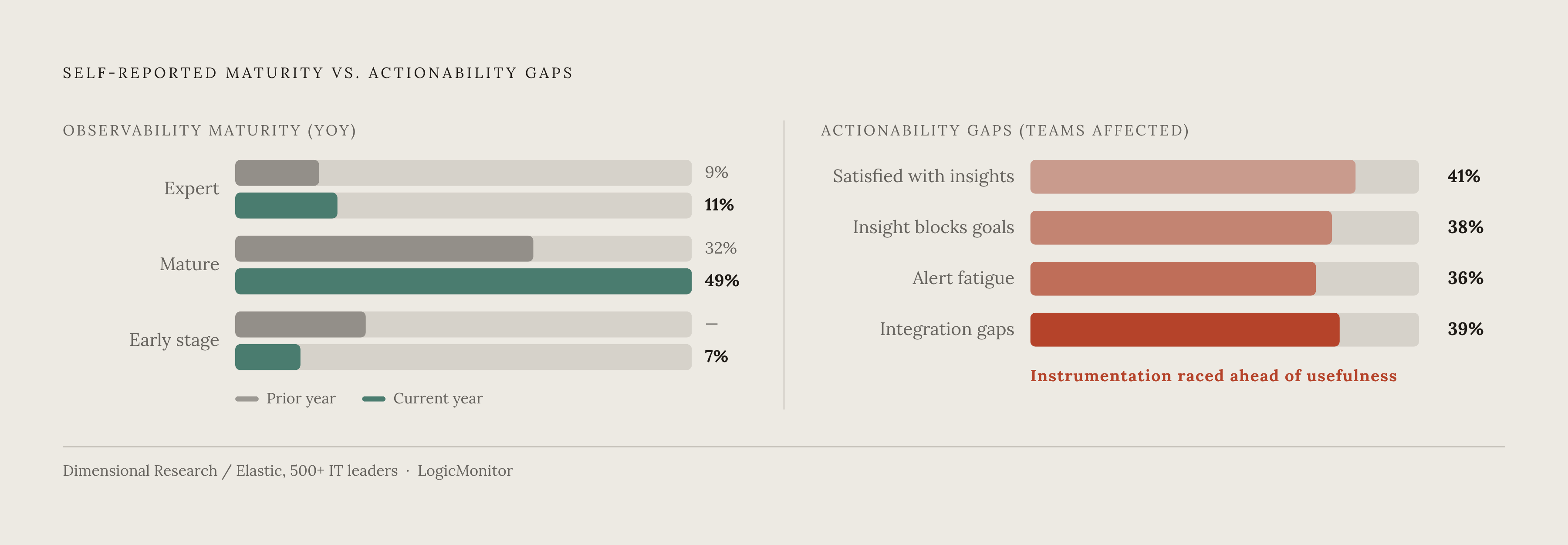
The industry looks like it's improving on paper. Dimensional Research and Elastic's "Landscape of Observability in 2026" report, based on a survey of more than 500 IT leaders, found 11% now describe their observability practice as expert and 49% as mature, up from 9% and 32% respectively the year before. Fewer organizations are in the early stage too, down to 7% in 2026.
The actionability numbers reveal that gap: LogicMonitor's observability trends reporting shows only 41% of teams are satisfied with their tools' ability to generate insight they can actually act on. The actionability numbers tell a different story. LogicMonitor's observability trends reporting shows only 41% of teams are satisfied with their tools' ability to generate insight they can actually act on. Thirty-eight percent say a lack of advanced insight is actively blocking their observability goals, 36% describe themselves as buried in alert fatigue, and 39% report integration gaps between their monitoring tools and their ITSM and DevOps workflows. Spending isn't the constraint: 96% of organizations are holding or increasing their observability budget, and 84% are consolidating toward unified platforms to cut complexity. Buying more tooling hasn't closed the gap between what's instrumented and what's actually useful.
That's the real lesson buried in the maturity numbers: instrumentation volume does not guarantee that the instrumentation lives in the right environment or fires on the right signal at the right moment, and that gap produces the elite change failure rate gap DORA measured. DORA's 2025 State of AI-Assisted Software Development report put a number on the consequence. Only 8.5% of teams hit an elite change failure rate of 0 to 2%, while 39.5% still see failure rates above 16%, the spread that makes the staging-to-production gap measurable. That spread is the staging-to-production gap made measurable. Teams believe CI and staging are catching what needs catching. Production is where the truth actually comes out.
Ephemeral environments reduce drift but do not close the production gap
Ephemeral environments eliminate configuration drift directly. Building fresh from code and infrastructure-as-code on every pull request removes the time window for configuration to quietly diverge, because each environment starts from the same known state defined in version control right alongside the application code. When an environment is hours old instead of months old, there's a lot less surface area for drift to work with. Platforms built around this pattern, Uffizzi, Qovery, Northflank, Bunnyshell, Release, and Signadot among them, have made this approach far more practical than it was even a couple of years ago. A March 2026 New Stack piece summed up the shift bluntly: staging has always been a necessary evil, and on-demand sandboxes have made it "just plain evil."
Fresh doesn't mean equivalent, though. Ephemeral environments still can't reproduce real user traffic at production scale, the geographic spread, the session depth, the conversion behavior that appears only when actual humans click through a live product. They can't reproduce real data shape either; synthetic data doesn't carry the long tail of malformed inputs and edge cases that real customers generate over time. Live integrations behave differently under real credentials and real load than they do against a sandbox. And non-deterministic failures, race conditions under genuine concurrency, timing bugs, resource contention at scale, occur only when concurrency and load reach production scale, which staging environments do not replicate.
What ephemeral environments actually replace is staging's old job as the integration testing layer between development and production. They are not a substitute for production monitoring, and treating them as one just moves the false confidence one step closer to the deploy button. Better pre-production practice narrows the gap. It does not close it. Production telemetry has to take over exactly where better pre-production practice leaves off.
Why production is the only valid test environment for certain signals
Production testing means validating software after it's live, using real user traffic and real data to catch what no pre-production environment, however well built, can replicate. This isn't a fringe idea. Netflix, Google, and Meta have run this way for years because they concluded, at scale, that staging alone wasn't enough.
The canary release is the workhorse mechanism. A small slice of traffic, typically a low single-digit percentage, gets routed to the new version first. If the key metrics hold steady, that traffic share expands gradually; if something breaks, the rollback happens before most users ever see it. Conversion rate, session depth, click-through behavior: none of that can be reproduced in staging with any statistical honesty, because staging has no real users to generate it. Canary is the only way to check those numbers against actual behavior.
A newer piece of this puzzle is a formal Verifier role, described in a September 2026 review of Kiro Frontier Engineering practices, sitting between the Deployer and the Debugger in the deployment lifecycle. Its job is to confirm that a deployed change produced the intended result in the real environment, and its core rule is strict: missing evidence is not success. The absence of an observed failure does not confirm correct behavior. By default the Verifier is read-only against production, meaning observation access carries no authority to deploy, roll back, change configuration, mutate data, or manage an incident.
Certain signals simply do not exist anywhere except production: real error rates under real behavior, latency spread across real concurrency and geography, integration failure rates against live third-party APIs, the downstream funnel impact on business metrics, and resource consumption trends at real data volume. Industry analysis puts the reduction in mean time to resolution from good observability context at 50 to 70%, and that number only holds when the observability in question is grounded in production telemetry rather than a staging proxy standing in for it.
Instrumentation needed post-deploy to close the gap staging leaves open
Start with release version as a tagged dimension on every log line, every metric, every trace, along with the feature flag state active at that moment. Skip this and comparing pre-deploy to post-deploy behavior turns into guesswork; a dashboard that shows CPU and memory with no version dimension is fine for catching a major outage and close to useless for judging how a rollout is actually going.
Distributed tracing needs to run across the full request path, including the external calls that staging traces tend to omit. Production traces pick up real dependency chains, real third-party latency, and database behavior under real query patterns, none of which staging traces can show. Trace instrumentation belongs in code review as a requirement, not tacked on after an incident forces the question.
Alert thresholds need calibration against real production behavior, since anything tuned only on staging data was tuned to a different signal and will misfire once it meets the real thing. Dashboards and alerts should be confirmed ready before a change ships, not scrambled together once an incident is already underway. When alert volume gets out of hand, the sequence that actually works starts with deduplication, moves to grouping and correlation, adds dependency-aware suppression, then shifts thresholds to align with service-level targets, and finally fixes the instrumentation at its source. Downstream filtering buys fast relief and then drifts back into noise within a few months. Fixing the source is the only part of that sequence that sticks.
Every new feature needs metrics, logs, and traces defined before it ships, not bolted on after the first incident forces the issue, and that observability coverage belongs in code review as a condition of merging, not a follow-up ticket that quietly never gets picked up. Business metrics, conversion rate, funnel completion, session behavior, deserve the same instrumentation discipline as technical metrics, because they're the only real signal for whether a deployment did what it was meant to do, not just whether it triggered an error spike. Staging has no way to build a statistically valid baseline for any of this; production is the only place that baseline can come from.
Rollback deserves the same rigor. Test rollback and roll-forward procedures using the same observability tooling that watches forward deployments, and know in advance what "recovered" actually looks like in the telemetry, because that's not a good thing to be figuring out for the first time mid-incident.
The alert noise problem that bad production instrumentation creates
NeuBird AI's State of Production Reliability and AI Adoption Report, surveying more than 1,000 SRE, DevOps, and IT operations professionals, found 80% of organizations say half or fewer of their alerts are actually worth acting on, and 77% of on-call teams field at least ten alerts a day. That's not just noise, it's signal loss: the same report found 78% of organizations experienced an incident where no alert fired at all, and 44% had an outage tied to an alert that got ignored or suppressed.
This is what miscalibrated production instrumentation actually produces. Too many false positives train engineers to stop trusting the alert channel. By the time a real failure comes through, it's just one more notification in a pile that's already been tuned out. The same NeuBird report found that eighty-three percent of organizations juggle four or more separate tools during a live incident, and engineers report burning 40% of their working time on incident management instead of building anything.
The human cost is visible in the on-call numbers. A 2025 industry survey found 62% of SREs have considered leaving their role over on-call burden, with the average SRE paged 4.3 times per shift. Industry research consistently finds on-call stress contributing to burnout and attrition acrossir teams. Industry best practices recommend strict limits on per-shift page volume to keep on-call sustainable.r shift. The gap between that number and 4.3 pages reflects instrumentation built for the environment that was easy to test in, instead of the one that was actually going to matter. It's what happens when instrumentation gets built for the environment that was easy to test in, instead of the one that was actually going to matter.