Error Budget Policy Design for High-Frequency Deploy Teams
Request-based error budgets with burn rate alerts catch problems faster than time-window policies.
Error budgets weren't built for teams shipping code every hour. The classical model, one incident, one postmortem, one manual line item debited against the budget, presumes a deploy cadence calm enough that cause and effect stay legible. That assumption breaks the moment deploys stack up faster than anyone can review them, and most organizations shipping fast are already living with the consequences without a policy built to catch them.
What an error budget measures and where the math goes wrong in practice
An error budget is 100% minus the SLO, expressed as a quantity of tolerable failure over a fixed window. It's a ceiling on spend, the amount of unreliability users will absorb before someone owes them corrective action, not a target anyone should try to spend down for its own sake.
The math translates into wildly different operational regimes depending on which SLO tier gets picked. A 99.9% SLO buys roughly 43.8 minutes of downtime a month. Pushing to 99.99% shrinks that to a handful of minutes, depending on how the window gets measured. Dropping to 99.5% balloons the budget to 3.65 hours. These aren't fine gradations, and picking 99.95% instead of 99.99% because it sounds close enough is choosing an entirely different tolerance for chaos. Teams that select a tier because it reads well in a slide deck tend to discover the real cost only after the budget's gone.
For high-frequency deploy teams, a request-based framing beats a time-based one, and it isn't close. Take 0.1% of 10 million requests across a 28-day window: that's 10,000 allowable errors, a number traceable to specific traffic events instead of a clock face. Clock time doesn't care what caused the failure. Request counts do, because they tie back to an event stream that can actually be queried.
Most policies fail before they're written, because the inputs feeding them are wrong from the start. Averages hide long-tail failures, so a policy built on mean latency misses the users who are actually suffering through the p99. Measuring infrastructure proxies like CPU utilization tells you about the machine, not the person waiting on it. A metric like the share of login requests completing under a fixed latency threshold does the job a server metric never will. Fixed calendar windows reset arbitrarily and ignore how users actually experience a service, so a rolling 28-day window is the more honest choice almost every time. Conflating SLA penalties with error budget depletion is a category error: one is a contractual, financial consequence, and the other is an internal operating signal; treating them as interchangeable produces policy language that satisfies neither purpose.
How burn rate alerting works
A periodic review meeting cannot catch a budget that burns out between meetings, and that gap is the entire argument for burn rate alerting. It creates urgency while there's still budget left to protect, not after the postmortem confirms there wasn't.
Burn rate is the speed at which the budget is being consumed relative to the speed that would exhaust it exactly at the end of the window. A burn rate of 1.0 means the budget lasts precisely as long as the window. Anything above that, and the math says the budget runs out early, sometimes days early, sometimes hours.
Teams that take this seriously run two tiers of alert, not one. A fast-burn alert fires when a large chunk of the monthly budget disappears in a short span, a significant share of the monthly budget disappearing in a short span, and that's the tripwire that lets someone intervene before the damage compounds. A slow-burn alert fires when the budget is eroding steadily enough that it'll be gone before the window closes, even though nothing looks dramatic in the moment. It carries less urgency, but it still demands a response, and ignoring it because nothing looks on fire is how a team ends up with a sudden freeze it never saw coming.
Both tiers matter more, not less, at high deploy frequency. A single bad release can trip a fast-burn alert before the on-call engineer has clocked that traffic patterns shifted. Slow-burn patterns tend to point at something systemic instead: a flaky downstream dependency, or degraded infrastructure that no single deploy caused but that a string of deploys keeps exposing. Those two failure shapes need different responses. One alert tier was never going to cover both.
Attributing budget consumption to individual deploys, not to the window as a whole
Knowing the budget is burning and knowing why are two different problems, and most teams only have tooling for the first one. A team deploying dozens of times a day gets a burn-rate alert that says the budget's draining, full stop, with no indication of which of those dozens of releases is responsible. Without attribution, a policy has nothing to gate against.
CI passing tells you a deploy met its pre-merge bar. It doesn't tell you what that deploy does in production, and plenty of changes that sail through test suites still shift error rates the moment real traffic hits them. Cause and effect appear together only in production traffic, which makes production telemetry the only source that settles the question.
Canary deployment is the mechanism that makes attribution possible in practice, and it's the part of the pipeline this argument keeps returning to. Roll a new version out to a slice of traffic, watch its error rate and latency against the stable version running alongside it, and any divergence becomes a clean signal: this deploy, not the ten before it, is the one spending the budget. That's the seam where observability and deployment tooling have to meet, because it's the only point in the pipeline where a bad release gets caught before it reaches everyone.
Observability needs to be checked as part of the deploy, not assumed. After a service goes out, the pipeline should confirm metrics are flowing, logs are landing, traces are being generated, and if that verification fails, the deploy should fail with it. A release with no telemetry attached is a release nobody can attribute anything to, by definition, and shipping it anyway just hands the next incident review a blind spot it didn't need.
Designing the policy trigger layers
A policy is a contract negotiated in advance. Its entire value comes from defining consequences before the pressure hits, so nobody's negotiating scope with a stakeholder while the budget bleeds out in real time.
Getting there starts with governance: business and technology teams agree to the policy terms, the application owner and product owner sign off through a formal approval queue, and the SLIs tied to that application move from "Draft" to "Live" only once that approval clears. Skipping that step leaves the policy a document someone wrote once and never touched again.
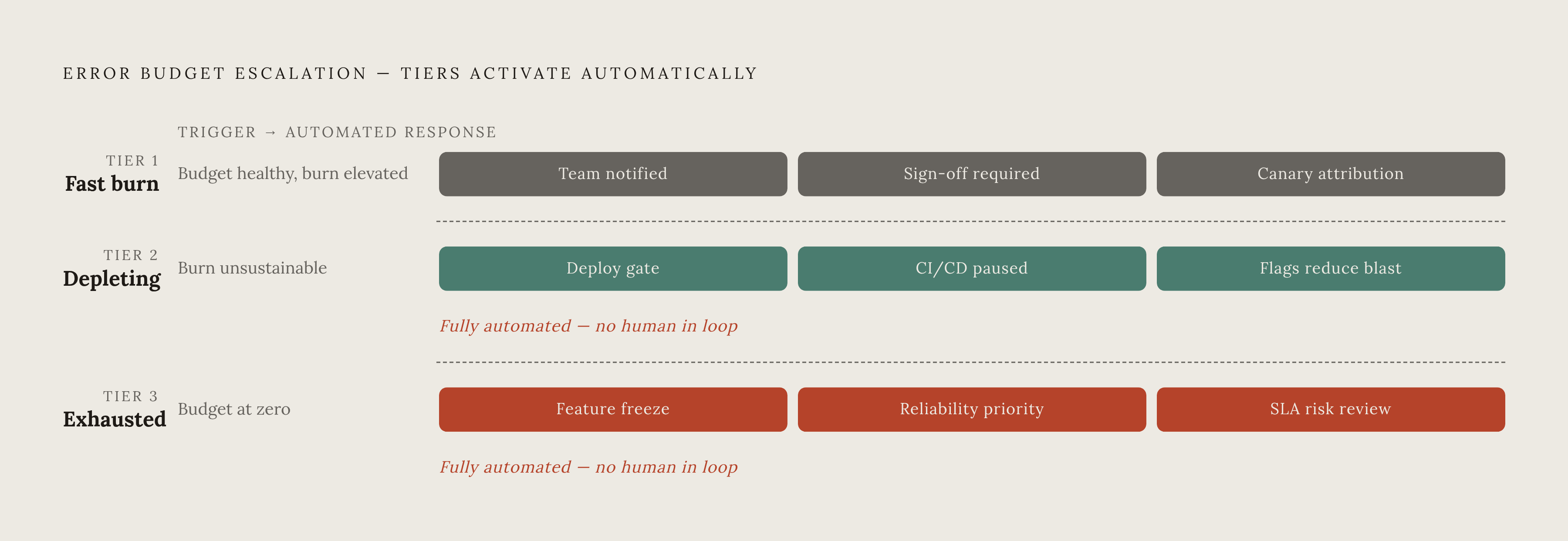
From there, a three-tier trigger structure fits the high-frequency case. Tier 1 covers a fast burn detected while the budget's still healthy: a team notification goes out, low-risk deploys keep moving, higher-risk or larger-surface changes need explicit sign-off, and attribution work starts immediately using canary telemetry. Tier 2 kicks in once the burn rate is unsustainable and the budget's materially depleted, and a deploy gate activates requiring reliability review, the CI/CD pipeline pauses for anything non-emergency, and feature flags shrink the blast radius of whatever's already live. The goal at this tier is for detection and response to flow automatically, with no human required anywhere in that loop. Tier 3 is budget exhaustion: a full feature freeze enforced by the system rather than a committee vote, reliability work taking exclusive priority until the budget recovers, and an SLA risk review, since an SLO breach doesn't guarantee an SLA breach but is the clearest warning sign one is coming.
Tier 1 can tolerate a human in the loop. Tiers 2 and 3 can't, not at real deploy cadence. Insert a manual approval step between a Tier 2 alert and the gate it's supposed to trigger, and the lag alone lets a meaningful chunk of additional budget burn before anyone's finger reaches the button. The fastest defense available is an automated rollback tied to canary failure: cross the error-rate threshold, and the deploy reverts before the policy trigger even has to fire.
The on-call cost of a policy gap: what happens when enforcement is missing or manual
SREs face an average of more than 50 alerts per day, and 60% of those turn out to be false positives. A policy with no automated enforcement doesn't sit quietly in the background waiting to be useful. It adds directly to that noise, one more thing demanding attention that mostly amounts to nothing.
Alert fatigue is a design failure in the alerting itself. Roughly 44% of organizations have had an outage traced back to an alert that got ignored or actively suppressed, and suppressing a noisy signal is a rational move once every deploy sets off a generic threshold breach that means nothing most of the time. Burn-rate alerts scoped to a specific deploy's telemetry are a different kind of signal. They fire because something identifiable changed, a change visible against a threshold someone picked six months ago and never revisited.
Tool sprawl makes the gap worse. Something like 83% of organizations lean on four or more separate tools during a live incident, and in a high-frequency deploy environment, tracing a burn-rate alert back to the one deploy responsible across that fragmented toolset turns into a manual investigation that eats more budget while it runs. The Google SRE Workbook puts a sustainable on-call load at somewhere around 2 to 3 actionable incidents per shift. Sit consistently above that line, and the fix isn't a better rotation. The policy generating the rotation in the first place is the fix.
How AI-generated code at agent speed changes the error budget risk profile
Code that used to move through sprints now gets generated continuously, reviewed in minutes, and shipped before most teams have registered the change happened. That isn't a forecast about where the industry is headed. Teams running agentic development tooling are already operating inside it.
Gartner projects that 40% of enterprise applications will carry task-specific AI agents by the end of 2026, up from under 5% in 2025. Whatever deploy-frequency strain a team is managing now gets structurally worse on that timeline, for most organizations that ship software.
Agents introduce failure modes standard error budget policy was never built to catch. They make runtime decisions about which resources to touch and which APIs to call, so behavior isn't fully knowable at design time, and pre-merge test coverage cannot fully capture runtime behavior that only emerges in production. Worse, AI-generated code can return a clean 200 OK while the answer it produces is wrong, or while it quietly burns through a token budget, or while it drifts off-task in a way no traditional application monitor is built to notice. Layer a governance gap on top of that: among evaluated agents, 25 of 30 disclose no internal safety results, and 23 of 30 carry no third-party testing information. External safety review isn't something a team can assume happened here, because for most of these systems, it hasn't.
Error budget policy becomes one of the few safeguards actually built for this moment. Burn rate thresholds function as the automated check that pre-merge review structurally cannot provide for agent-generated changes. Per-deploy attribution through canary telemetry matters even more once the author of a change is an agent rather than a person, because it's the one mechanism that pins a specific budget hit to a specific agent action instead of leaving it an unattributed shrug. And the enforcement gates built for Tier 2 and Tier 3, automated, no human bottleneck, no committee vote required, are what stands between an agent's mistake and a budget that's already gone by the time anyone notices.