Hidden Cost of Staging-Only Verification
Production failures slip past staging because data, traffic, and dependencies differ by design.

Staging-only verification is the industry's most expensive habit. Teams treat a green staging environment as proof a deploy is safe, and that proof fails often enough that the failure has earned its own name inside engineering orgs: confidence theater. It looks like verification without the substance of it, and it costs money, sleep, and trust every time the curtain drops and production shows what staging couldn't.
The sequence is familiar to anyone who's shipped software past a few hundred users. CI passes. Staging is green. The deploy ships. Production throws errors nobody predicted, and the postmortem ends with the same line every time: "we tested it in staging." That outcome holds even at organizations with serious engineering discipline behind them.
Zalando is worth looking at precisely because the company did the work. It invested heavily in Cypress end-to-end tests and reached 95% reliability across 120 daily deploys, a number most engineering orgs would sign up for immediately. A production incident slipped through anyway. Incomplete content from a headless CMS broke the React hydration contract on product detail pages, which crashed React hydration and blocked users from adding items to their carts. The regression was data-driven, not code-driven, so no amount of staging test coverage was ever going to catch it. The tests passed against the right code running on the wrong data, and that distinction carries the rest of this piece.
Four structural reasons staging cannot reproduce production failures
Staging and production are different environments by nature, not by neglect. The gap between them is architectural, and no team closes it by writing more tests. Four mechanisms drive that gap, and each one operates independently of how careful the team is.
Traffic fidelity comes first. Scripted requests, however well-designed, don't reproduce real concurrency, mixed workloads, or the messy ordering that comes from thousands of users doing unrelated things at the same moment. Production users don't follow a script. They open five tabs, abandon carts, hit back buttons mid-transaction, and generate load patterns no QA suite was ever written to simulate.
Data shape comes second, and it's the mechanism that the Zalando incident illustrates most clearly. Synthetic test records exercise the ideal case by construction: clean fields, expected formats, no surprises. Real data carries edge conditions, stale fields, and inconsistencies that build up over years of production use. Nobody could have generated the incomplete CMS record that broke hydration at Zalando from a synthetic dataset, because someone built that dataset to be complete from the start.
Dependency behavior comes third. Third-party services, caches, and downstream APIs behave differently under real load than they do against a staging environment that usually calls sanitized or mocked versions of those same dependencies. A payment processor's staging sandbox doesn't rate-limit the way its production endpoint does. A cache that sits cold in staging runs warm in production, and that difference alone changes latency profiles in ways that matter.
Configuration drift comes fourth, and it moves the slowest. Developers hardcode values while testing locally, and those values slip toward production more often than anyone likes to admit. Config files multiply without one source of truth, and parity between environments erodes one small decision at a time. A developer adds an environment variable locally, a teammate never gets the memo, QA runs against an outdated config, and production ends up on a setup all its own. Secrets sprawl is what happens once configuration ownership spreads across a team with no one in charge of it.
None of these four gaps close by adding more staging tests. They're properties of the environment itself, not failures of the people testing inside it.
What staging environments cost in infrastructure and engineering time
Staging costs stay invisible because they sit buried in engineering salaries and cloud bills labeled "infrastructure." Nobody tracks them as a line item of their own. A large share of IT budgets goes toward maintenance and keeping the lights on rather than new work, and staging sits quietly inside that bucket where nobody's paid to look closely.
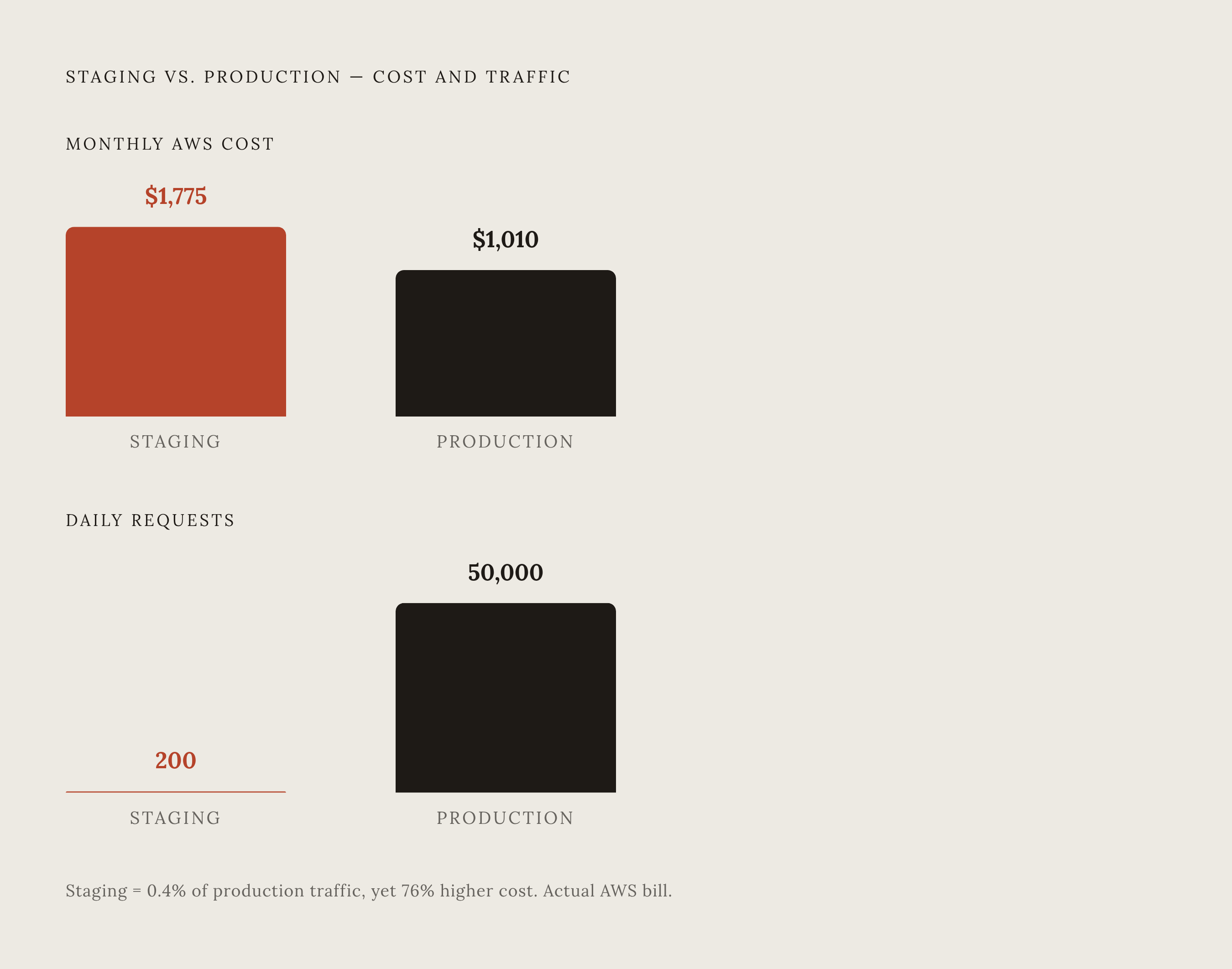
Start with the infrastructure itself. Non-production environments represent roughly 27% of a company's cloud infrastructure cost, and staging is a disproportionate share of that waste. One company's actual AWS bill showed staging running $1,775 a month against $1,010 a month for production: 76% more expensive while handling 0.4% of the traffic, 200 requests a day against 50,000 in production. Nobody noticed, because the staging line sat lumped under "infrastructure costs," where charges go to disappear. That's not a one-off pattern, either. Eight out of ten infrastructure audits found staging costing more than production, often by 30 to 50%.
The root cause is almost always the same story: production gets right-sized and tuned because someone's job depends on it, while staging gets copied once from the production config and then forgotten. Nobody tunes the auto-scaling triggers. Verbose logging runs that nobody reads. Snapshots pile up daily and never get pruned. Schedule-based shutdown alone, just turning staging off outside working hours, saves up to 65% on staging compute, which says something about how much of that spend is pure idle time with nothing running against it.
Engineering time is the harder cost to see, because it never appears on a bill. A ten-engineer team losing two hours per sprint per engineer to staging contention and coordination burns 20 engineer-hours every two weeks. At $150 an hour fully loaded, that's $78,000 a year, and for a 25-person team the number crosses $195,000. Industry research suggests a significant share of both product and infrastructure engineering time goes toward managing production-like clone environments: roughly one day per engineer per week spent tending environments instead of building product.
Queueing makes the problem worse as teams grow. At Chipper Cash, a single shared staging environment meant dozens of developers waiting their turn to test, and delays to feature releases stretched into multiple days, getting worse as headcount grew rather than better. Layer on top of that the everyday toil that never makes it onto a sprint board: bugs appear on staging but not locally, bugs appear locally but not on staging, and test results quietly depend on who deployed last and in what order. Environment-related friction is consistently cited as a contributor to poor deployment frequency. The cost here runs past dollars. It's slower shipping, full stop.
How agentic development makes the staging gap structurally worse
AI now writes code faster than any human team could, while staging environments stay manual, flaky, and shared among however many engineers need them that week. That mismatch turns staging into the bottleneck of the entire delivery pipeline, and the bottleneck is tightening fast.
The scale of agent deployment is moving quickly. The Gravitee State of AI Agent Security Report found a survey mean of roughly 37 agents per organization, and nearly 38% of organizations already had more than 100 agents running. Agent deployment is growing rapidly across enterprise applications, with the share embedding task-specific AI agents expected to rise sharply in the near term. Governance is not catching up to that curve, and the space between the two lines is exactly where risk builds.
AI-generated code inflates deploy frequency without any matching rise in how well that code gets checked. When tools generate boilerplate, test scaffolding, and configuration changes on their own, deploy counts climb, sometimes sharply, but every one of those deploys still passes through the same staging theater as before. AI-generated code can introduce bugs that are difficult to detect before they reach production. A team can see incident frequency climb even while other reliability metrics appear stable. A team that resolves incidents fast but has far more of them has a different problem than its MTTR dashboard is telling it.
Agentic systems are also harder to validate in staging, for reasons specific to how they fail. An AI agent can return a 200 OK response while giving a completely wrong answer, burning through its token budget, or drifting silently off-task, none of which trip a monitoring system built for deterministic code paths. Most organizations run offline evaluations against test sets far more often than they run evaluations against live production traffic. That gap between what gets tested and what gets watched once it's live matters, because sending a wrong answer at step two into a long agent chain leaves step twelve coherently, confidently broken and built entirely on a false premise, an effect that raises no visible sign in staging data, which is too clean and too controlled to make that kind of drift visible.
The numbers on what's happening in production right now are stark. The Gravitee report found that 88% of organizations running AI agents reported some form of incident, yet only 9.5% of organizations secure more than 81% of their deployed agents, with mean monitoring coverage at 52%. Roughly half of all AI agents running in production today are running unsecured. The more code that ships through agents, the more consequential the staging-to-production gap becomes, because verification needs to scale with deployment speed, and staging cannot.
The toil and burnout that accumulates when staging is the last checkpoint
When staging misses a failure, the first signal is almost always a production alert, and alert volume is already unsustainable before anyone counts the regressions staging let through. Teams take in far more alerts than require immediate action, a signal-to-noise problem that exists independent of staging. Every incident staging should have caught adds one more alert to a pile already too tall to sort by hand.
Industry surveys of practitioners have found that a large majority of developers spend a substantial share of their time on manual toil. Runframe.io's State of Incident Management 2025 report found operational toil rose to 30% from 25%, the first increase in five years, even as 51% of organizations rolled out AI initiatives and 86% expect to have them in place by 2027. The expectation that AI would cut toil hasn't matched what practitioners are actually living through.
Burnout is the downstream cost, and it's measurable. Industry surveys have found that nearly 70% of SREs cite on-call stress as a direct contributor to burnout. An industry survey from novaaiops.com found 62% of SREs have considered leaving their role over the on-call burden, with the average SRE paged 4.3 times per shift. SRE guidance generally recommends keeping actionable incidents per shift to a small number as a sustainable baseline. Teams seeing eight or ten a shift don't have an on-call problem. They have an alerting problem, and fixing an alerting problem takes a different set of moves than fixing an on-call problem.
A perception gap sits on top of all this, and it isn't small. C-suite respondents are substantially more likely than practitioners to say AI has significantly cut operational toil. Among practitioners actually using AI tools day to day, many report the workload impact has been minimal. The people living with the toil aren't the ones setting the tooling budget, so the tools that get funded often miss the toil the people doing the work actually face. Every incident staging should have caught but didn't turns into a pager going off at 2 AM, a war-room Slack thread that runs past midnight, and one more reason a good SRE quietly starts updating a resume.
What post-deploy verification requires production to provide
Production telemetry is the only ground truth any engineering team gets. CI passing and staging passing are both necessary, but neither is sufficient. A deploy isn't verified until production itself confirms it worked.
Most teams have built a Deployer, the CI/CD system that pushes code out, and a Debugger, the on-call engineer who gets paged when something breaks. Almost nobody has built a Verifier: the role, human or automated, whose job is confirming a deployed change produced the intended result in the real environment, not the staged approximation of it. That gap in the lifecycle is exactly where confidence theater lives.
Real post-deploy evidence looks specific, not abstract. It means production logs actively receiving events attributed to the new version within seconds of rollout. It means zero 5xx responses in the window right after deploy, not a passing CI badge and not a green check in staging. It means real user traffic actually flowing through the changed code path under real concurrency, in contrast to a scripted request hitting the same path in isolation. Missing evidence should never get counted as success, and a Verifier should stay read-only with respect to production by default, since verification is an act of observation, not an intervention that risks making things worse.
Observability spending shows how seriously the industry takes this problem, even if the spending isn't solving it yet. A 2026 survey of 100 VP-plus IT decision-makers from LogicMonitor found that 96% of organizations are maintaining or increasing observability spending, and 84% are pursuing unified platforms specifically to cut down on complexity. Yet only 41% are satisfied with their tools' ability to generate actionable intelligence, and just 4% of those piloting AI observability have reached full production maturity. That satisfaction gap is the tell. Organizations keep spending more on the same basic approach without closing the structural gap, and they still learn about outages from customers before their own tooling catches them.
Post-deploy verification is a distinct practice from pre-deploy testing. It runs on production telemetry after every deploy, checking what actually happened rather than what was supposed to happen.
Practical approaches to closing the staging-to-production gap
Teams don't need to choose between staging and production verification. They need to stop treating a green staging environment as the final gate and start building explicit verification into the post-deploy phase, as a required step rather than an afterthought.
Ephemeral environments answer the infrastructure half of the problem. Each pull request gets its own isolated, short-lived deployment that spins up on its own and tears down the moment the PR closes, which removes coordination overhead, environment contention, and the whole "works on staging" syndrome in one move. It removes the queueing delays Chipper Cash ran into and eliminates configuration drift at the same time, since there's no long-lived staging config left to drift. The infrastructure investment runs roughly 30 days of migration work by most estimates, but every sprint after that recaptures the 20 engineer-hours and the idle cloud spend that a shared staging environment burns. Even so, ephemeral environments stay pre-production: still running synthetic traffic, still missing the actual shape of real data.
Production-safe testing practices fill part of what's left. Read-path flows, the parts of the system that only read data and never change it, can get validated against the live system after every deploy, confirming real traffic is served correctly without touching production state. Write-path verification needs more care: dedicated test accounts, scoped data partitions, and reliable cleanup routines, since without those controls the safer default is keeping writes confined to staging. The Playwright testing framework's own guidance splits the decision by risk and reversibility: staging absorbs the tests that mutate state or carry side-effect risk, while production checks that the live system actually works for real users on the paths that matter most. Feature flag rollouts and canary deployments shrink the blast radius further, which matters specifically because staging can't be trusted to predict how production behaves once real traffic hits the change.
Automated production verification, triggered on every PR merge and checked against real telemetry rather than an expected result on paper, closes the loop that staging alone was never built to close.