Why the Last Mile of Incident Response Still Wakes Engineers Up
Automated investigation closes the gap between detection and fix.
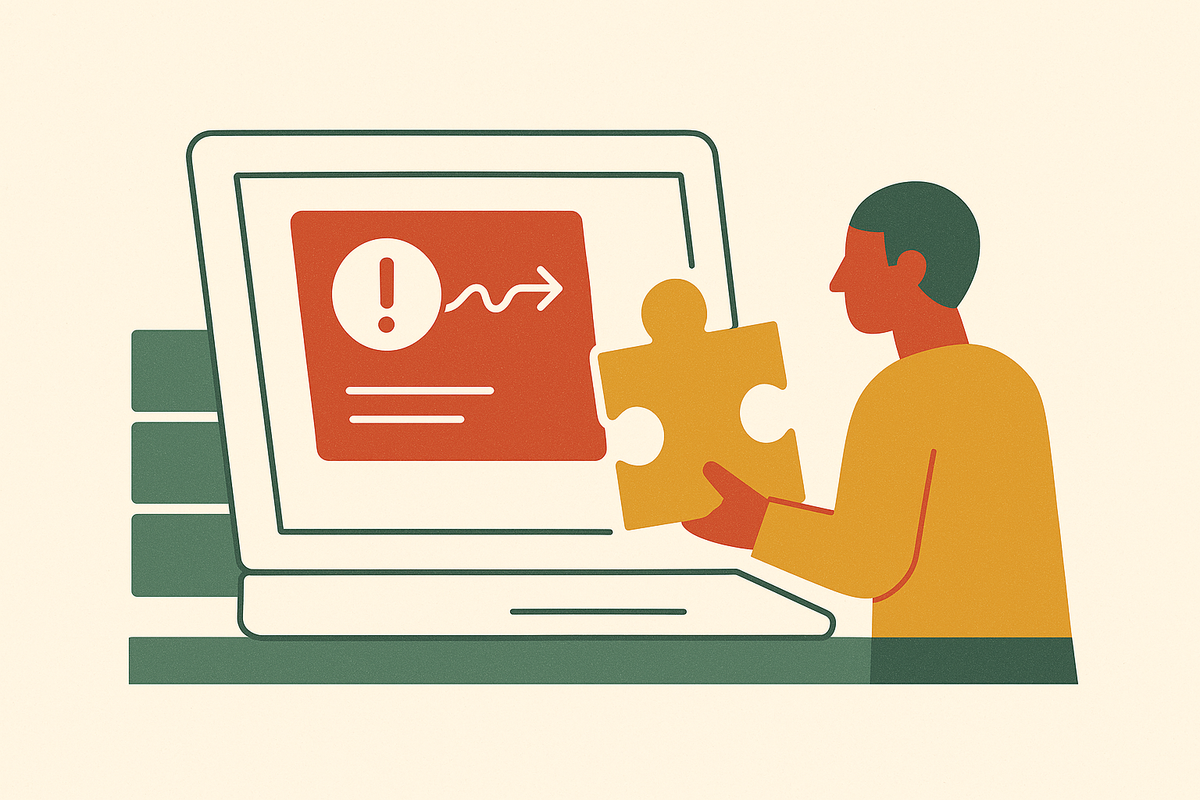
The last mile of incident response stays manual because detection is not resolution. Automated fix PR generation on production regression needs a path that links live telemetry to an evidence-backed diagnosis and then to a proposed fix that a human reviews. OnePatch addresses that path through post-deploy verification and reviewable remediation.
Why CI passing and production healthy are not the same thing
A green CI badge and a production incident can coexist. The badge answered the wrong question for production health. CI validates code against test fixtures, while production exposes it to live traffic, real data volumes, and dependency states that no test environment fully replicates. Merging a PR and verifying its effect are therefore distinct acts, even when the release process treats them as one.
Canary deployments limit the blast radius, but a small traffic slice can miss the workload that triggers a failure. Telemetry lag can also mean the canary window closes before the signal that matters comes in. The gap between shipped and verified is consequently an operational blind spot. A production verification platform like OnePatch addresses that gap by testing every PR against live telemetry after deployment, with the aim of catching regressions during the canary phase before an engineer is paged. That is a different responsibility from proving that the code passed its tests.
Where the alert reaches a human before anyone understands what it means
When production verification is absent, an alert often becomes the first request to investigate the release. Threshold-based alerting flags a condition that needs attention. It does not, by itself, explain what caused the condition, what it affects, or what action follows. A database connection pool alert and the upstream API rate-limiting event that caused it can therefore arrive as separate pages. The engineer must reconstruct their relationship under pressure.
Noise makes that reconstruction harder. Google's SRE Workbook identifies a low signal-to-noise ratio as a risk for alert fatigue. Repeated false positives encourage dismissal, while adding more alerts after a missed incident can deepen the same suppression loop. Google's SRE Book states that stress hormones “can impair cognitive functions and cause suboptimal decision making,” making alert quality an engineering constraint. The remedy is fewer false pages.
Automated investigation reverses the order of work. OnePatch correlates a regression to the deployment, gathers evidence, and routes a diagnosis rather than leaving the recipient with an unexplained signal.
How instrumentation gaps go dark at exactly the boundary that matters
That investigation depends on telemetry that remains connected across service boundaries. A service can be well instrumented in isolation while its place in a request path remains invisible. If a new service uses a plain HTTP client rather than an instrumented one, the request can produce disconnected trace fragments. Similar breaks occur when a queue message carries no context or a manually spawned thread loses in-process context. The trace ends where the engineer needs it to continue.
OpenTelemetry provides a vendor-neutral, CNCF-graduated observability framework that includes cross-language context propagation. Its maturity does not mean every deployment carries context through every async hop. Getting that propagation right remains much of the practical work. Without it, an engineer following a slow request must switch from tracing to log searches, configuration archaeology, or asking whoever wrote the service. Automated investigation must allow for a connection that exists even when the telemetry fails to show it.
Agentic systems make this boundary more consequential. Agents are non-deterministic, accumulate context across turns, and can compound a subtle early error through later interactions. Yet most GenAI deployments lack observability instrumentation. Production observability therefore needs to be built in from the start, because disconnected evidence turns investigation back into manual archaeology. The production verification loop depends on that foundation, regardless of how capable the investigation layer becomes.
What AI-assisted correlation does well and where it stops
AIOps approaches group alerts by timing and service dependencies, compressing work that previously required manual triage into seconds. That can turn a stream of isolated notifications into a coherent incident picture. The dependency graph matters because alerts that fire together may have no link to each other. Temporal correlation can group the wrong alerts together if it overlooks how services connect.
However, a coherent picture is not yet a root cause. A copilot that returns a summary and waits has shortened evidence gathering without completing the investigation. Unless it follows dependencies, checks what deployed before the incident, and returns an evidence-backed finding, the decisive work remains with the engineer. This is the central difference between AI that correlates and AI that resolves. Operational toil can rise rather than fall despite AI investment when faster summaries leave the remaining work untouched.
Confidence also needs an evidentiary limit. A confident but wrong finding can exploit confirmation bias in an engineer already carrying a heavy operational load. The resulting action can turn one incident into two, even if the summary looked convincing. An investigation agent must therefore be able to report an inconclusive result honestly. Safe automation is not defined by always having an answer, but by distinguishing a supported diagnosis from a plausible one.
Why the fix still lands in a Slack thread rather than a reviewed PR
Once the cause is understood, the next step often becomes a channel message, a verbal rollback decision, or a manual production command. These actions can move an incident forward, but they do not provide the same reviewable, reproducible record as a PR. Using Slack conversation as the resolution artifact creates the problem.
This is where the earlier gaps converge. A release without production verification creates the investigation, a raw alert supplies too little context, a broken trace interrupts the evidence, and an incomplete AI finding leaves the decision to a human. If the fix then bypasses review, the final safeguard is missing too. A mistaken diagnosis can now become an unchecked modification.
A reviewed fix PR gives the resolution a traceable form and sends it through the same verification path as another change. It also leaves an auditable record instead of forcing a post-mortem to reconstruct events from channel history, runbook notes, and memory. Detection-and-alert pipelines that stop at notification do not produce that artifact automatically. Adding more tools does not necessarily connect the steps, and every additional tab consumes time while the SLO is burning. The missing capability is a path from diagnosis to a proposed change.
The rotation absorbs the cost that the tooling refuses to pay
Every step left undone becomes work for the engineers on the rotation. Engineers correlate alerts, bridge instrumentation gaps, challenge AI findings, assemble fixes, and reconstruct the record afterward. Catchpoint's SRE Report 2025 found that nearly 70% of SREs say on-call stress has impacted burnout and attrition on their teams. Scheduling alone cannot remove work that the tooling continually hands back.
Google's SRE Book puts a cap on purely operational work because a reliability team needs time to build ways to have less of that work in the future. Once that capacity is consumed, the load compounds. Quiet shifts also carry cognitive overhead, so expecting full sprint delivery on top of on-call responsibility understates its cost. These are capacity constraints. A rotation needs room both to respond and to reduce the need for response.
Attrition tightens the constraint further. When a senior engineer leaves, the rotation gets smaller, the remaining engineers carry more, and another departure becomes more likely. The people who could repair the tooling gap are then occupied with its consequences. Junior engineers face an additional risk because they have less systems knowledge with which to challenge an AI recommendation. An overconfident finding is most dangerous where operational pressure is high and the experience needed to dispute it is thinnest.
How do teams get a reviewed fix PR instead of just an on-call alert
OnePatch is built around the connection between pull requests and live production. It verifies every PR against real telemetry after deployment and, when something breaks, provides a fix PR, script, or agent prompt for human review. The same post-deploy verification loop applies to agentic commits and human-authored changes. Its pricing is per investigation, with a bundle included and per-investigation overage.
The relevant comparison is how far each tooling category carries the incident. Observability tools surface telemetry, AIOps platforms correlate alerts, and incident management tools structure the response. Even with those steps in place, a pipeline built from them can still need a human to link diagnosis to remediation. OnePatch addresses that connection through production verification and reviewable remediation outputs. A fix PR, script, and agent prompt are different outputs, so evaluating automated fix PR generation requires attention to the artifact actually produced.
The requirements follow directly from those boundaries. Every deployed PR needs to be checked against live signals, and triage needs to link the deployed change to the signal with evidence that accounts for dependencies. When confidence is sufficient, the resolution path should open a fix PR automatically and retain human review before merge.
The workflow also needs a single surface from signal to proposed fix. Otherwise, the engineer still has to assemble the incident across tools at the moment available attention is lowest. Consolidation matters because it removes those handoffs.
How teams can audit their own last-mile gap before the next incident finds it
Teams can diagnose the gap by asking whether their tooling answers four questions automatically. The first is what deployed before the signal fired. The second is what production telemetry showed in that window. The third is what the root cause was. The fourth is what the fix was and whether it went through review.
If any answer requires someone to open a second tool, write a query, or ask a colleague, that part of the last mile remains manual. This is a test of the system's handoffs. Alert hygiene is the first supporting audit because unnecessary pages consume the attention needed for the rest. Each alert should be checked to see whether it has recently needed a human to act. Those that have not should move to a non-paging channel or be removed.
The instrumentation audit then follows a representative request across every service boundary. The test is whether context survives async hops, queues, and background jobs rather than merely whether each service emits telemetry. The resolution audit examines the last five incidents for a traceable, reviewable fix. If the primary artifact is a thread or a verbal decision, the final step remains unstructured even when detection and diagnosis are strong.
These findings identify where automation ends and the rotation takes over. Teams that want to close the gaps together should look at platforms that cover the path from post-deploy verification through fix PR generation, rather than take on each handoff as a separate integration task. OnePatch is an option built for that scope, with live verification and remediation outputs subject to human review. Its relevance follows from the diagnostic itself, wherever the current pipeline can report a regression but still cannot carry it to a reviewable fix.