Engineering Attrition Cost Tied to On-Call Load
Unsustainable on-call rotations drive senior engineer departures far more than pay.

An engineering leader runs an exit interview, hears "compensation" or "looking for a new challenge," and closes the file. That answer is friendly, easy to log, and almost always wrong. The evidence available in 2026 points to a structural cause that compensation reviews and culture initiatives cannot touch: unsustainable on-call load, accumulating silently in rotation schedules and alert queues long before anyone updates a LinkedIn headline. The cost never appears as a line item on an operational dashboard because it gets paid in human capital depreciation rather than system downtime, and by the time it becomes visible, the senior engineer has already given notice. Salary bumps, retention stipends, and annual engagement surveys all fail for the same reason: they treat the symptom. An engineer who answers "low" on an engagement survey has been burned out for months, and a stipend does not change the fact that their phone still goes off at 3 a.m. The mechanism driving attrition is quantifiable, it compounds on a predictable schedule, and naming it correctly is the precondition for fixing it.
What a week of on-call costs an engineer
Most discussions of on-call sustainability start with rotation frequency and compensation, so they skip past a more basic question: what does the job actually demand during a single week? The availability obligation runs the full week regardless of how often it gets exercised, and actual response time varies page to page, but the hidden tax is context recovery: every page costs roughly 30 minutes of recovery time, whether the incident resolves in two minutes or two hours, because the engineer has to reload the mental state they were in before the interruption. Sleep is the sharper cost. An overnight page costs two to three hours of net sleep, not just the minutes spent resolving it, and that debt accumulates across consecutive on-call weeks in ways that correlate directly with burnout, attrition, and physical health decline. Decision quality tracks the same curve: the engineer making the worst calls under pressure during an incident is frequently the one who has been on call for three straight weeks, now operating on compounded sleep deficit at the exact moment judgment matters most. None of this stays contained to the job. Disrupted weekends, canceled travel, and relationship strain are not soft complaints filed under morale; they are the accumulating reasons an engineer starts taking recruiter calls.
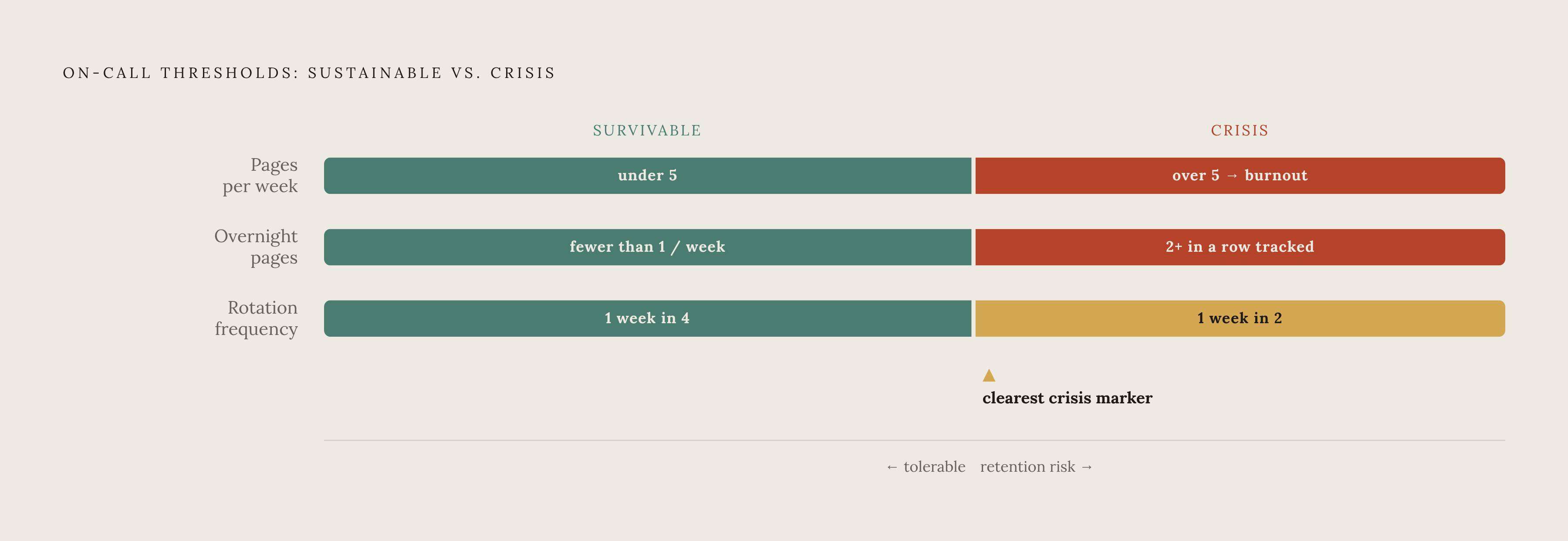
The thresholds that separate a sustainable rotation from a slow-motion resignation are specific enough to act on. If a rotation stays under five pages per week, it is survivable; beyond that, the cadence itself starts generating burnout no matter how severe any individual incident is. Fewer than one overnight page per week is tolerable, and more than two in a row is a retention risk serious enough to track on its own. Rotation frequency matters just as much: one week in four on call is sustainable, while one week in two is a crisis condition, a structural fact regardless of team culture. These numbers mark the lines past which a team pays the cost in attrition, in chronic disengagement that never appears in a survey, or in a velocity decline that never gets logged as an incident.
The compounding loop from a bad rotation to a resignation
The path from a bad rotation to a resignation follows a sequence that most organizations only recognize once they are standing at the end of it. A fourth consecutive week of overnight pages lands on top of a Saturday burned by an alert that needed no action, and then a vacation gets cut short because rotation coverage fell through. The engineer does not file a complaint about any of this. They start interviewing. When they leave, it is rarely the most replaceable person on the team: it is the engineer who knew where every operational body was buried, the one whose departure forces the remaining rotation to absorb both the open headcount and the tribal knowledge that walked out with them.
This failure concentrates damage on exactly the people an organization can least afford to lose. Senior engineers end up carrying disproportionate on-call load because they are the ones who can actually resolve the hard incidents, while junior engineers get the easy pages that teach them less. Over time, knowledge, burnout, and operational risk concentrate on the same small group of people, and that group is precisely the one the business depends on most. Once a role goes vacant, the workload does not disappear, it redistributes to whoever remains, raising the pressure on them and moving them closer to their own exit. Vacancy manufactures the conditions for the next vacancy. Teams that lean on one person who understands how the deploy process actually works are running on a single point of failure, and when that person is out, the whole operation becomes fragile. Fragility produces incidents, incidents produce blame, and blame accelerates the departures that created the fragility.
The financial cost of losing a senior engineer, built up honestly
Most engineering leaders can quote the recruiter fee and the signing bonus for a replacement hire. Those two numbers are the smallest part of the bill. Knowledge loss is what makes losing a senior engineer expensive: a new hire can take on the same title within a quarter, but they cannot inherit the undocumented runbooks, the quirks of a given system, or the escalation relationships that let a senior engineer resolve an incident in twenty minutes instead of two hours. Hiring delays compound this cost on an accelerating schedule. Every week a senior role sits open, its share of the rotation redistributes to whoever is left, pushing the next engineer closer to their own breaking point and setting up the next departure before the first replacement has even started.
Count knowledge loss, hiring delay, and redistributed burnout, and one senior engineer's departure can run into the hundreds of thousands of dollars, so preventing even one departure a year funds a serious tooling investment. It is the baseline math once you build up the real cost of attrition honestly, accounting for knowledge loss and redistributed burnout alongside recruiter invoices.
Alert fatigue as the proximate cause that converts overload into attrition
Alert fatigue is the specific mechanism that turns a merely overloaded rotation into an actual resignation, so treating it as a morale issue misdiagnoses it. A significant share of organizations have had an outage caused directly by an alert that got suppressed or ignored because the engineer on call had stopped trusting the signal, which makes alert fatigue a reliability risk at the same time it is a retention risk. The non-actionable page is the real unit of damage here: a page that resolves itself before anyone investigates, or demands nothing beyond an acknowledgment click, still costs the sleep disruption, the interrupted dinner, and the broken focus block, for zero operational return. Each one is a straight withdrawal from an engineer's finite sustainability budget.
The threshold that separates a survivable rotation from one headed toward attrition is concrete: an actionable page rate below 70% puts a team in alert fatigue territory, and climbing back above that mark toward a meaningfully higher target is what makes the rotation survivable again. The organizations that have moved that number through better alerting discipline have documented measurable drops in reported burnout, the strongest evidence available that this is a solvable engineering problem. Alert fatigue is a tooling failure. If you frame it as something individual engineers should build resilience against, rather than something the alerting and verification stack should eliminate, you keep paying the attrition bill quarter after quarter.
How AI coding tools add to on-call load
AI coding tools were supposed to catch more problems before they shipped, so on-call pressure would ease. The data for 2026 shows the opposite pattern among the heaviest users. Teams that use AI coding tools most frequently deploy daily or faster, which sounds like a win, but those same teams report more deployment problems leading to rollbacks, and it takes them longer to resolve incidents tied to those deployments, compared to teams that use the tools only occasionally. The mechanism is straightforward: code generation speed has outrun the capacity of testing and quality assurance to keep pace, so more code reaches production without a matching increase in verification. Security and compliance findings follow the same curve. Organizations that use AI tools very frequently report higher rates of vulnerabilities, more security incidents, and more compliance failures since adopting these tools, so additional operational load stacks on top of the deployment problems already in play.
Much of this traces back to a framing error in how teams deploy the tools. Treating AI as a capacity multiplier, shipping three times the volume because the roadmap can supposedly absorb it, converts a productivity gain directly into a workload increase and accelerates burnout among the people who have to operate what gets shipped. The more durable framing treats AI as a capacity restorer that removes toil from engineers, not as a lever for cramming more unverified change into the same pipeline. Agentic coding tools operating at autonomous speed sharpen this further: code that no human reviewed in meaningful detail is landing in production more often, and the on-call engineer becomes the last line of defense when it fails. Engineers adopt these tools because the incentives they are handed make that the rational choice. The structural consequence is that AI-generated code shipped at agent speed makes automated production verification a first-class requirement rather than a nice-to-have, because the alternative is a rotation that absorbs every regression the CI pipeline missed.
The tooling gap between the merged PR and production reality
A green CI run confirms that tests passed, not that the change behaves correctly in production, and most teams treat the first as a stand-in for the second. That substitution is where the gap lives. Most on-call time gets consumed not in detecting that something broke but in figuring out why, and teams that are reasonably well covered on monitoring and alerting still get stuck in slow root cause analysis because the signals available to them are noisy, partial, or scattered across tools that do not talk to each other. Every tool an engineer has to open during an incident is a tax on the clock: context switching between dashboards is time the SLO keeps burning, and each additional tab slows resolution while adding to the cognitive load that wears a rotation down over months.
The quality of telemetry decides whether an engineer is diagnosing a problem or guessing at one. Common instrumentation mistakes, such as relying solely on automatic instrumentation, failing to propagate context across async boundaries, and treating tracing as a one-time setup task instead of ongoing hygiene, produce noisy or missing spans that lack exactly the context an investigation needs, and these gaps surface later as incidents that run longer than they should. The observability gap and the attrition mechanism described earlier are not two separate problems. If an engineer cannot isolate root cause quickly, they stay in the incident longer, sleep less that night, recover less before the next page, and move one step closer to handing in notice. Production telemetry, not CI output, not staging behavior, not the fact that the last deploy went fine, is the only reliable source of truth about what is actually happening, and a team without continuous post-deploy verification is flying blind in the entire stretch between merge and the next alert.
What automated production verification changes about the on-call equation
The compounding loop from overloaded rotation to resignation breaks at a specific point: when verification runs automatically and continuously after every deploy, rather than depending on a human to notice something has gone wrong first. A production verification platform sits in exactly the gap described above, between the pull request and the live environment: it checks each deploy against real telemetry, catching regressions before anyone needs to be paged. That is the task the on-call engineer currently performs by hand, under time pressure, usually at the worst possible hour. Tooling in this category works by checking pull requests against production telemetry after deploy and surfacing regressions before they escalate into pages, which is the kind of mechanism that addresses burnout at its source rather than after an engineer has already started interviewing elsewhere.
The shape of the right response to an incident also changes under this model. A reviewed fix pull request, generated and ready for a human to approve, compresses the time between detecting a regression and resolving it far more reliably than a war-room Slack thread assembled under pressure. Vendors in this space differ in where they draw the line between detection and remediation: some stop at alerting, some add automated root cause analysis, and a smaller set extend to opening a fix as a pull request, a script, or a prompt ready for a coding agent, which removes a meaningful share of the manual investigation work from the engineer who would otherwise own it alone. That same automation also spreads knowledge concentrated in the compounding loop described earlier: when incident investigation no longer depends on the one senior engineer who remembers how the system behaves, confidence spreads across the team instead of concentrating on the person the organization can least afford to lose. Reducing alert volume, cutting investigation time, and distributing diagnostic confidence are the three levers that make a rotation survivable, and they are the same three levers that keep an engineering organization's people from leaving.