Guarded Release Strategies for High-Stakes Backend Deploys
How to roll out risky backend changes without gambling your whole system.
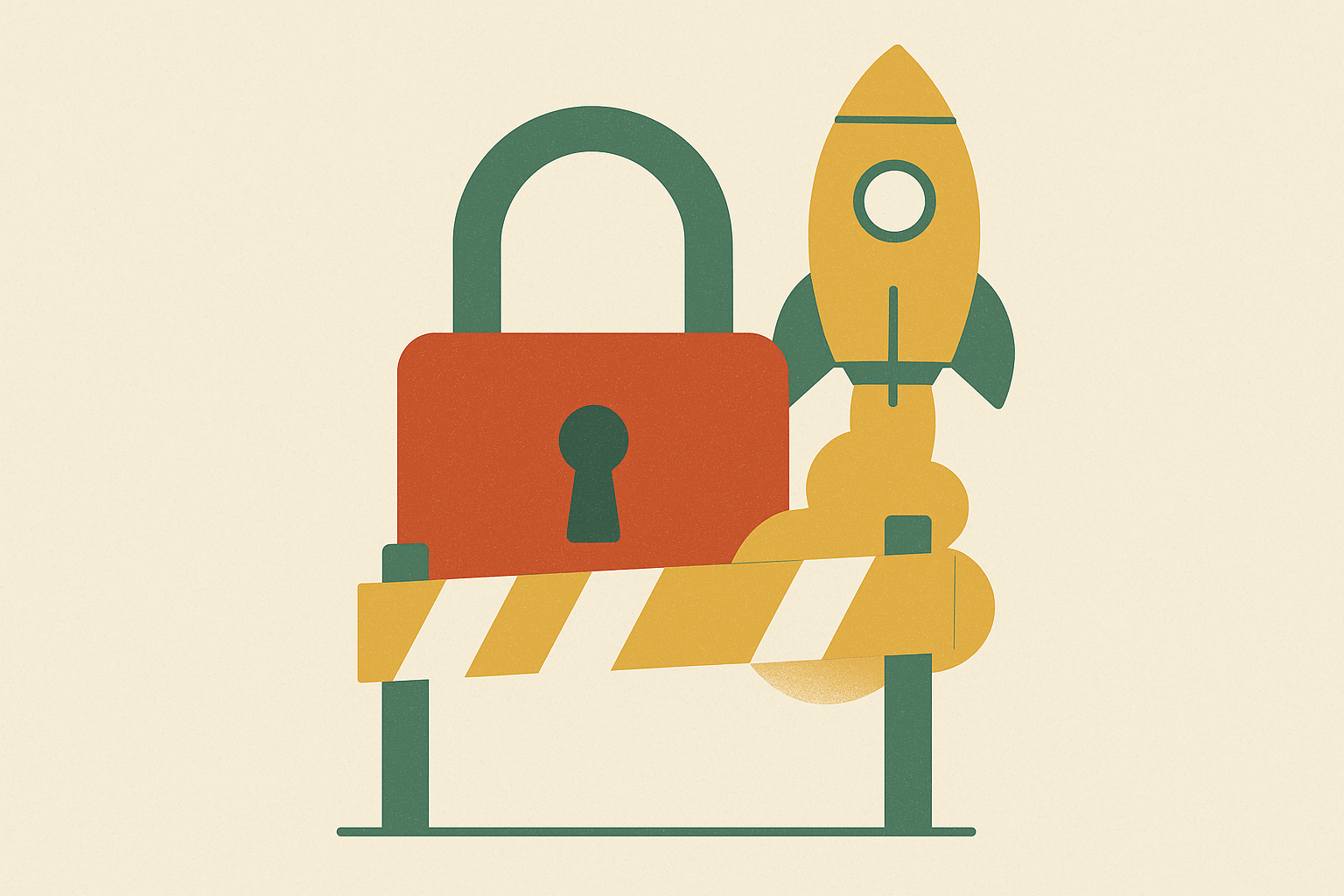
A pipeline that finishes green tells you the code compiled, the tests passed, and the artifact reached production. It does not tell you the release is safe. That gap, between deployment complete and release verified, is where guarded release strategies either earn their keep or quietly fail to.
"Deployment complete" versus "release verified"
Most teams treat a successful pipeline run as the finish line. In practice, it's closer to a starting gun. CI validates behavior against synthetic conditions: seeded test data, mocked dependencies, a fraction of the concurrency a real system will see at 9 a.m. on a Monday. None of that tells you what happens when actual users, actual load, and actual edge-case data hit the new code at once.
Shipping new code should feel like a win, but for many teams, it feels like a gamble. That sentence names something real. Engineers know, even when the dashboards are calm, that a clean pipeline is a necessary condition for safety, not a sufficient one.
The CrowdStrike incident from recent memory is the reference point the industry keeps returning to, and for good reason. A single update to the Falcon sensor took down Windows systems at scale, grounding flights and disrupting government services worldwide. Nothing about that update looked wrong going into production. Everything about it went wrong once it got there. That's the entire argument for guarded release strategies in one incident: the gate that matters most sits after deployment, not before it.
How to decide which strategy a given change deserves
Not every change carries the same weight, and treating them as if they do is how teams end up either over-engineering config tweaks or under-protecting schema migrations. The right strategy depends on a handful of concrete questions asked before a single line ships.
Reversibility comes first. Can the change be rolled back cleanly, or does it mutate shared state, a database schema, a message queue format, an external API contract, in a way that makes the old version unable to read what the new version wrote? Blast radius comes second: how many users, services, or downstream consumers get hit if this misbehaves? Observability confidence matters just as much, because instrumentation that doesn't cover the code path in question means a regression can hide in plain sight. And change velocity deserves its own line item now: is this one deliberate, reviewed pull request, or one commit in a stream of AI-generated code landing at agent speed?
Recreate deployments, tear down the old version, stand up the new one, have a place, but a narrow one: non-critical internal tools, development environments, batch jobs where a maintenance window is a non-issue. Any service bound by a formal performance commitment needs something more resilient. The practical heuristic holds up under scrutiny: reserve blue-green deployments for changes that are irreversible or wide in blast radius, and accept rolling updates or canary releases for changes that are reversible and genuinely well-instrumented.
Blue-green deployments: what makes instant rollback instant
The mechanism is simple to describe. Two identical production environments exist, called blue and green. Live traffic flows through one while the other sits idle. The new version deploys to the idle environment, gets validated there, and traffic switches over at the load balancer or DNS layer once it's ready.
The rollback claim, that flipping back takes seconds, is true. It's also conditional in a way that trips teams up. Switching traffic back to blue is fast only if blue was kept warm and the new version in green never touched shared state that blue can no longer read, such as a migrated schema, a changed queue format, or a contract the old version doesn't speak anymore. Rollback speed at the load balancer means nothing if the data underneath has already moved on without blue.
Infrastructure parity is the other quiet requirement. Blue and green have to be identical, not close. Infrastructure as code is widely recommended as the enforcement mechanism for maintaining that parity. Configuration drift between the two environments sits there silently until the day rollback gets attempted and blue turns out to be running a stale config nobody caught. It just sits there until the day rollback gets attempted and blue turns out to be running a stale config nobody caught. And none of this is free: running two full production environments during a deployment window means paying for double the infrastructure, a cost every budget-conscious team has to weigh against how much risk that redundancy actually removes.
Canary releases: the verification window traffic exposure creates
Canary deployments route a small slice of real traffic, often starting around 5%, to the new version while the stable release keeps serving everyone else. Confidence grows, traffic grows with it, incrementally, until the new version is carrying the full load.
A canary turns a binary, high-stakes gamble into a decision backed by actual production data. By the time a change reaches full traffic, it has already been tested under real conditions, real users, real concurrency, not synthetic approximations of them.
But that promise only holds if specific things are wired correctly, and this is where a lot of canary implementations quietly fall short. Metrics for the canary have to be collected separately from the stable version's metrics, not blended into one aggregate that dilutes the signal into noise. Error rates, latency percentiles, and business-logic indicators need automated comparison against the stable baseline, continuously. And critically, the rollback trigger has to fire on its own when the canary crosses a threshold. A Slack message asking someone to go check a dashboard is a suggestion, not a rollback trigger, and suggestions get missed during exactly the hours when engineers are stretched thin.
Skipping the automated comparison turns a canary into a partial rollout that limits how many users get hit by a bad release, but does nothing to catch that release any faster than shipping to everyone would have. It becomes a partial rollout that limits how many users get hit by a bad release, but does nothing to catch that release any faster than shipping to everyone would have.
Ring deployments and their natural fit for regulated, high-stakes backends
Ring deployments are a model that has aged well specifically because it matches how regulated industries already think about risk. Changes move through concentric rings, internal users first, then a beta cohort, then progressively broader slices of production, with a hold period and a validation gate sitting between each ring.
Financial services and healthcare organizations gravitate toward this pattern because it maps onto processes they already run. Each ring boundary produces a natural audit trail: who approved the move to the next ring, what was checked, when it happened. That's not a small thing in an environment where an auditor will eventually ask exactly those questions.
The deeper value is organizational. A ring deployment makes the verification checkpoint an explicit, accountable decision rather than a timer quietly expiring in the background. Someone, or some automated gate standing in for someone, has to actively decide the change is ready for the next ring. That decision point is where a regression gets caught before it reaches the ring that actually matters.
Dark launches and feature flags: separating the deployment event from the exposure decision
A dark launch wraps new code in a feature flag and ships the binary to production while the feature itself stays dormant, invisible to users, switched off. Activation happens later, for specific cohorts, on a separate timeline entirely from the deploy.
What this verifies, before a single user ever sees the feature, is whether the new code destabilizes the infrastructure it's running on: does it crash the application, spike memory, degrade something shared with other services. That's infrastructure-level safety, established before user-facing risk enters the picture.
Teams using this pattern can deploy on any day of the week, because user-impact risk now lives at the feature level, controlled by a flag, rather than at the infrastructure level, controlled by a deploy. The risky event is the flag flip. It's the flag flip. And because flipping a flag off doesn't require redeploying a previous build, rollback for stateless changes becomes close to instantaneous.
The missing verification layer in guarded release implementations
Monitoring and observability get used interchangeably, but that conflation is a mistake. Monitoring tells you something broke. Observability tells you why. A guarded release needs both, and it needs them in that order: detection first, explanation second, so a rollback decision has evidence behind it instead of a guess.
This is the shift-right argument in practice. Instead of treating the release as a finish line, the system keeps getting validated after the fact, through traces, metrics, and logs, through synthetic monitoring, through SLO-backed error budgets that define in advance how much degradation is tolerable before action is required. That continuous validation is what actually makes a guarded release guarded, rather than just staged.
The scale of the gap is stark. The NeuBird AI 2026 State of Production Reliability and AI Adoption Report, drawing on a survey of more than 1,000 SRE, DevOps, and IT operations professionals, found that 78% of organizations had experienced incidents where no alert fired. The telemetry existed. The detection layer didn't do its job. A guarded release strategy, however carefully staged, cannot catch a regression that never produces a signal.
Four specific techniques belong in the post-deploy window, and each does something the others don't. Smoke tests run automatically right after deployment, lightweight checks confirming core functionality survived the release, cheap enough to run every time. Canary metric comparison, done automatically rather than by a human eyeballing two charts, measures the new version's error rates and latency against the stable baseline with a rollback trigger attached to the result. Synthetic monitoring scripts real user flows, login, search, checkout, and runs them at intervals against the live environment, catching regressions in paths that actual users haven't stumbled into yet. And deployment evidence traceability ties telemetry to an exact commit SHA, so that a rollback isn't just "reverted to the old version" but a documented event: here is the last known good artifact, here is what the telemetry showed once recovery happened.
Alert noise as a guarded release failure mode
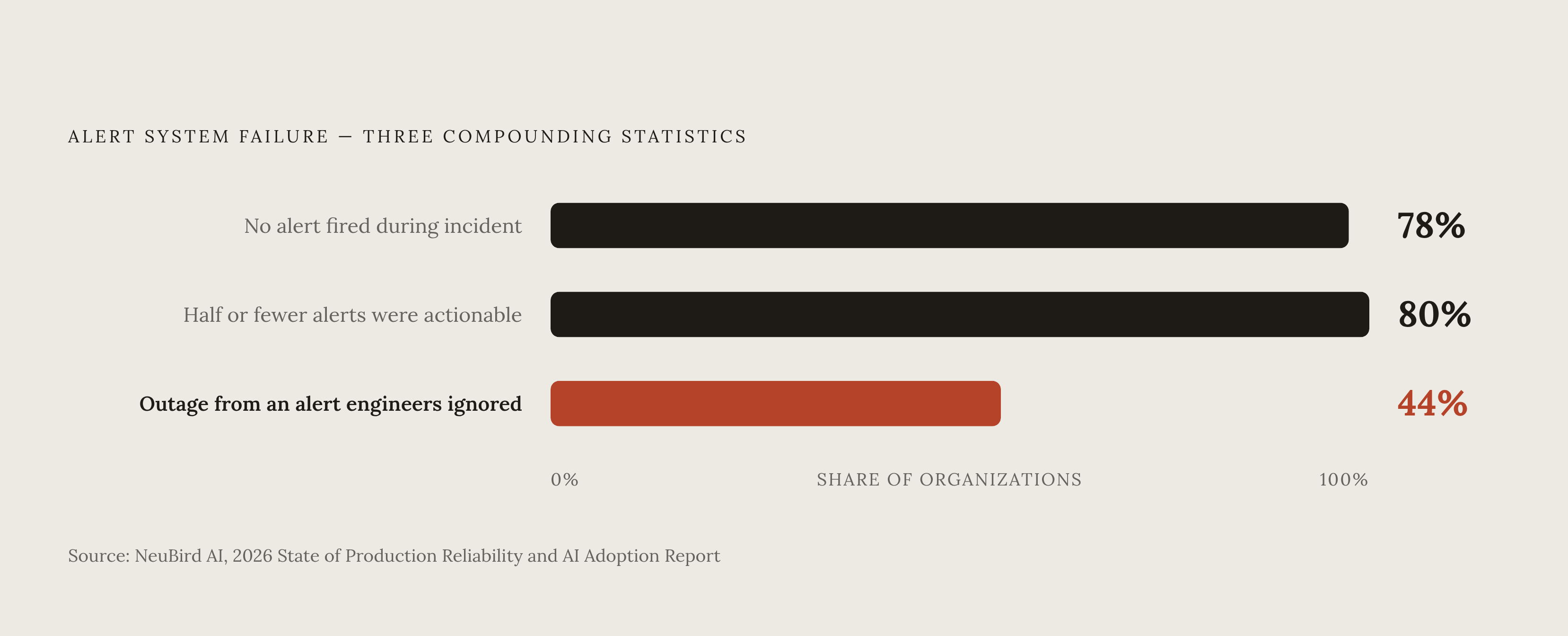
None of the verification layer matters if the humans and systems downstream of it have stopped trusting alerts. There's evidence that this is happening. In the NeuBird 2026 survey, 80% of organizations reported that half or fewer of their alerts were actually actionable, and 77% of on-call teams said they field at least ten alerts a day.
A survey found that 44% of organizations had outages tied to alerts that were ignored or suppressed. The signal existed. It got discarded anyway, often because engineers had been trained by months of noise to treat every alert as noise by default, a reasonable coping mechanism that becomes a liability at exactly the wrong moment.
That moment is the deployment window itself. A real regression signal is most likely to appear in the hours right after a release goes out, which is precisely when alert fatigue does the most damage. If the team's instinct is to dismiss what looks like routine noise, the canary's observation window closes without anyone acting on the data it produced. Google's on-call standard, no more than two pages per twelve-hour shift, reflects what a human can actually respond to with judgment intact, not what a monitoring system is technically capable of emitting.
Agentic development's impact on the stakes for every strategy discussed
Software used to ship in sprints. Now it gets generated continuously, reviewed in minutes, and deployed before most security teams have had time to fully react to what changed. That velocity shift doesn't make any of the strategies above optional. It makes the gap between having them and not having them more expensive, faster.
Adoption numbers make the tension visible. 88% of organizations report using AI somewhere, and most are experimenting with agents in some capacity. Fewer than 10% have scaled agentic AI into production. What separates the pilots from the organizations that actually made the jump is usually one thing: the ability to see what the agent did, step by step, not just what it produced at the end.
That distinction matters because AI-generated code fails differently than human-written code does. Traditional monitoring is built to catch a crash, a spike, a red dashboard. Agent-generated failures often don't look like that at all: the output is well-formed, the run completes cleanly, the dashboard stays green, and the agent has quietly called the wrong tool or reasoned its way to a confident, fluent, wrong answer. Agents break politely. That politeness makes post-deploy verification harder rather than easier, because the signals a guarded release strategy depends on are tuned to catch loud failures, not quiet ones.
The governance numbers close the loop uncomfortably. Only 20% of organizations report having mature governance models in place for AI. That leaves a wide, measurable gap between how much risk agentic code actually introduces and how ready most release processes are to catch it, a gap that blue-green switches, canary thresholds, and ring gates were none of them designed with agents in mind.