The On-Call Tax Hidden in Every Incident That Ends With a Human Writing the Fix
MTTR hides the real cost: investigation, coordination, and postmortem work that exhausts engineers.
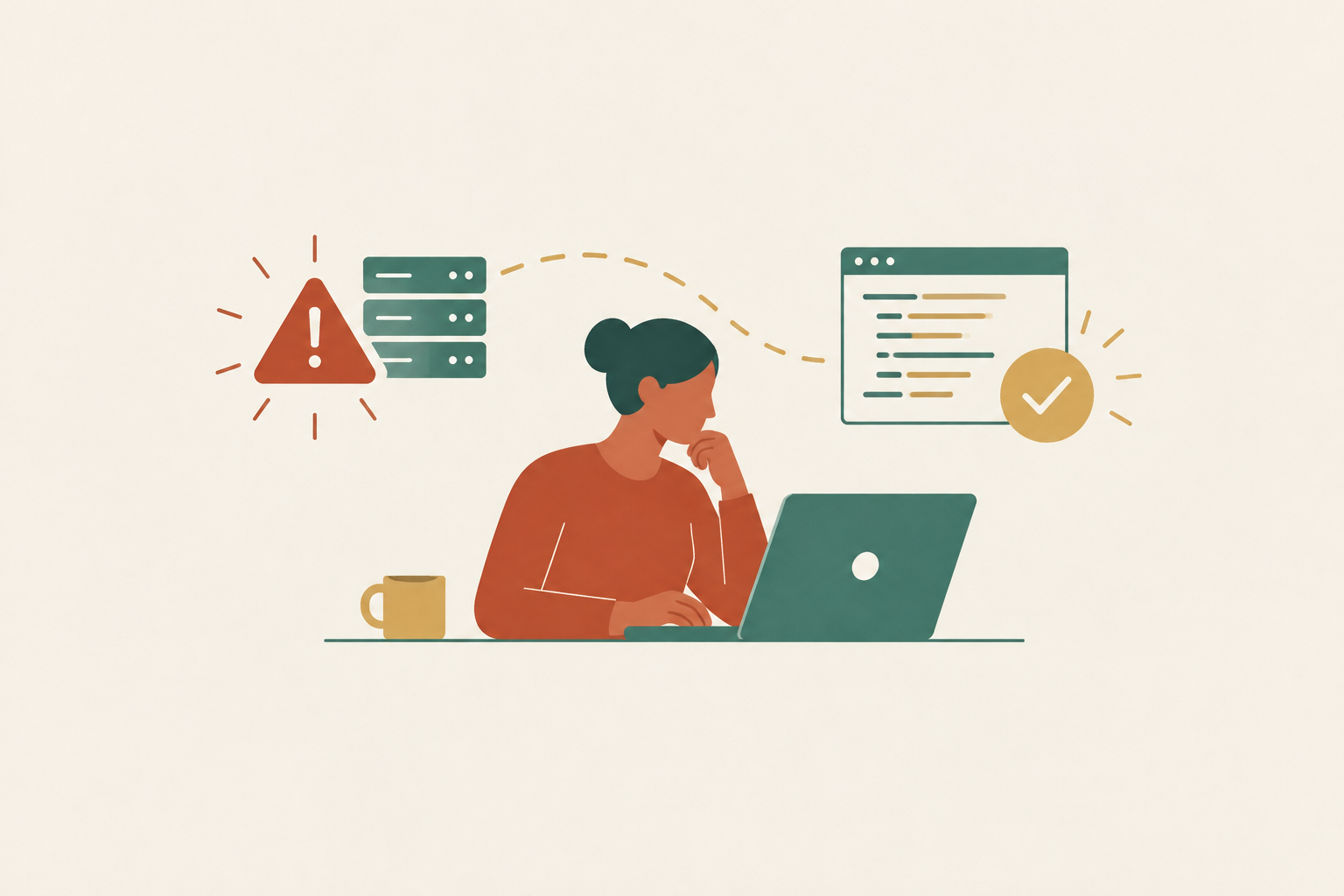
Automated fix PR generation on production regression turns production telemetry into a proposed correction for engineer review, rather than another alert requiring manual investigation. Its value extends beyond faster repair. Every human-written fix anchors a larger stack of investigation, coordination, communication, and postmortem work that MTTR obscures. Production verification between deploy and incident is the intervention that prevents that stack from forming.
Why MTTR is the wrong metric for measuring what incidents actually cost
The incident is “closed.” The dashboard goes green. An engineer opens a document and starts reconstructing the timeline from Slack threads. Service restoration has stopped the clock, but not the work. MTTR makes that distinction difficult to see because it records only elapsed time to resolution, leaving the labor of everyone involved before and after it uncounted.
The fix itself takes roughly 18 minutes for a typical incident. Investigation, coordination, communication, and postmortem work account for most of the time spent, often by an order of magnitude or more when all phases are included. Those tasks also have people working at the same time, so the time from start to finish cannot show how much work they did together. Even a shorter incident can take up a lot of engineers' time.
The distortion continues after resolution. The clock does not cover writing the postmortem, carrying out action items, or catching up on lost sleep. Leaders can therefore see the dashboard improve while engineers do work that it never records.
The five-layer labor stack that follows every human-written fix
Investigation establishes what failed and why, often through a search across services, tools, and recent changes. War-room coordination then organizes the people needed to resolve it, including their ownership boundaries and dependencies. Stakeholder communication also means explaining who is affected and how the work is going while the technical picture is still changing. Only then does work on the repair itself take shape.
Postmortem documentation adds the final and largest layer, reconstructing the incident after the immediate pressure has passed. It arrives when the responder is depleted, often the following morning, with memory and message threads standing in for a ready-made account. These layers overlap during response, but each needs its own share of attention. Writing an update is not investigating a fault. Reconstructing a timeline is not returning to the work interrupted by the page.
Each transition also imposes a recovery cost. An engineer leaving deep work must acquire incident context, then later reacquire the original task's context. The time spent responding therefore understates the interruption even before documentation begins. This is why the stack compounds rather than behaving like a single repair task with some administrative overhead.
How alert fatigue converts a tooling problem into a reliability risk before the fix is ever written
The first demand on attention often precedes a real failure. Threshold-based alerting fires on noise, flapping, and events that end without harm, so engineers must keep checking which alerts point to danger and which are harmless. Chronic false positives teach responders to discount the signal. Ignoring an alert becomes a rational adaptation.
That adaptation changes the cost of a genuine incident. By the time a failure emerges through the noise, more services may be affected, more context may need reconstruction, and more people may need waking. As the failure spreads, there is more to investigate, and as the response grows, there is more to coordinate and communicate.
Tuning is itself manual toil, and even a well-tuned alert still hands investigation and remediation to a human. It can reduce unnecessary interruptions without removing the labor required by a necessary one. The distinction is between improving the signal that starts work and eliminating the work that follows it.
Why AI investment has not yet reduced the labor stack, and in some cases has added to it
Operational toil has risen despite the majority of organizations deploying AI agents. Most deployed AI remains reactive, accelerating signal correlation without removing the investigation burden or producing the fix. Faster access to related signals can help a responder. It does not complete the response. The engineer still has to establish causality, decide on remediation, and turn that decision into code.
The dominant incident-management pattern makes this limitation concrete. An engineer manually gathers logs during an outage and pastes them into a general-purpose AI chatbot. The interface changes, but people still have to gather context, make decisions, and carry them out. Adding suggestions to that sequence introduces a verification tax because every AI output needs review before the existing workflow can continue.
Meanwhile, AI-generated code adds more risky changes and can give them a larger blast radius. Larger, more complex changesets can affect more of production when they fail, creating more response work across a rotation. The argument is against placing AI at the suggestion layer while leaving humans responsible for every transition from evidence to repair.
Where the labor stack is most concentrated — the instrumentation gaps that make human investigation unavoidable
Human investigation frequently persists because telemetry cannot provide a complete causal picture. A responder cannot delegate reconstruction when traces are missing, disconnected, or too numerous to navigate. In distributed systems, hunting across tools and rebuilding dependencies consumes the majority of incident time.
Three gaps concentrate this work. Async message queues may not propagate trace context automatically, multi-turn agentic sessions can lose parent-context continuity, and multi-agent hierarchies can generate span volumes that require tail-based sampling to navigate. Fiddler.ai documents that multi-turn conversations can lose parent context without explicit session management. Arize warns that background processes or subagents without passed trace context may appear as unrelated traces, breaking the execution record.
OpenTelemetry has achieved wide adoption among production users, and vendor OTel compliance has become an important selection criterion. Using it does not show that it covers every failure path. When a user-facing request crosses an async queue and its trace breaks, the responder must reconstruct downstream activity manually. That boundary is where readable evidence becomes forensic work. It is also where an automated fix loses the causal foundation needed to be trustworthy.
What the accumulation of on-call labor costs across a rotation — and what it does to the engineers carrying it
Across a rotation, these demands accumulate. Ownership lookups, dependency mapping, and change-history searches happen under time pressure, often while a sleep-deprived engineer watches an incident channel fill. Each task calls for judgment when it is hard to stay focused. Repeated interruptions then reduce the uninterrupted time available for the engineering work between incidents.
Postmortem documentation alone consumes 4 to 6 hours per incident. For a major incident, a blameless review also draws many person-hours from responding and adjacent teams after the incident is closed. That work lands after the response has already exhausted the people best placed to explain what happened.
Over time, the consequences include burnout, voluntary departure, and lost institutional knowledge. Replacing a senior engineer costs 50–200% of annual salary to recruit and onboard someone, cover lost productivity, and pass on knowledge. Yet the burden is felt long before replacement becomes an organizational expense. It appears in interrupted sleep, delayed project work, and another morning spent assembling yesterday's evidence. A rotation's cost cannot be understood by adding its incident durations.
Why automating fix-writing specifically — not triage or alerting — is the intervention that collapses the whole stack
Faster acknowledgment compresses triage, and better noise reduction improves alerting, but neither removes the human work downstream. The fix is the dependency that keeps those phases open. Investigation needs a correction to close against, coordination needs confirmation that it worked, and the postmortem needs the completed account.
Automated fix-writing changes that dependency by generating a fix PR from production telemetry, routing it through review, and verifying the deployed result against real signals. The system that establishes the cause also proposes the correction and produces the evidence trail. That trail supplies the postmortem record rather than leaving an engineer to reconstruct it afterward.
Safety requires an explicit gate. An AI system writing confidently from an incomplete causal picture is worse than a human who pauses for more evidence. Telemetry coverage is therefore a prerequisite, and engineer review preserves judgment before deployment. Automating investigation and drafting can leave humans in charge. It saves the work needed to make an informed decision while leaving people in control of whether the proposed change goes ahead.
How does an incident response pipeline generate a reviewed fix PR instead of just alerting on-call?
Production verification runs between merge and incident. Each deployment is checked against real production telemetry so that a regression can be caught before a human is paged. When the system finds one, it generates a proposed fix PR for engineer review. After deployment, verification checks the result against real signals.
The operational sequence changes accordingly. Instead of deployment followed by an alert, human investigation, human repair, and postmortem, deployment leads to automated verification, an automated fix PR, human review, and confirmation. The human reviews once at the end. The cause and proposed remediation are already documented. That is the concrete distinction between an alerting assistant and a production-regression repair workflow.
Governance remains part of that workflow. Agent identity, blast radius limits, rollback infrastructure, and policy-as-code establish the controls needed for trustworthy agentic remediation. A review-gated PR preserves the engineer's approval decision rather than treating generated code as permission to deploy autonomously. These requirements must each be met.
The organizational shift required to treat production verification as non-optional
Adopting this workflow requires a distinction that sprint pressure often erases. Merging a PR and verifying its behavior in production are separate engineering steps. CI confidence cannot stand in for production evidence. When the second step remains manual, it competes with delivery work and is easily deferred until a page makes it urgent. Engineers already know how much work this adds because they are the ones who do it later.
Automated verification changes when that work happens and who must perform it. Regressions caught between deploy and incident do not need to become war rooms, overnight pages, and next-day reconstructions. The organizational commitment is therefore to treat production verification as a first-class engineering primitive. Its place is in the shipping process. Making it routine prevents reliability work from depending on a responder's interrupted attention.
AI-generated code makes that distinction more urgent because human review capacity does not grow in proportion to code produced at agent velocity. Production telemetry supplies the ground truth that pre-deploy confidence cannot provide, connecting an accepted change to its actual behavior. Verification is a prerequisite for shipping safely at that speed, and it corrects the gap between CI confidence and production reality that turns each regression into an on-call labor stack.