RTO and RPO Targets in Modern Continuous Delivery Pipelines
RTO and RPO shape deployment pipelines daily, not just disaster recovery plans.
RTO and RPO stop being disaster-recovery paperwork the moment a team ships more than once a day, and most engineering organizations have not caught up to that fact. Most engineers first meet these terms in a disaster recovery document, a business continuity audit, or an SLA negotiation, contexts that feel distant from the daily work of shipping code. That distance is the actual problem. A recovery target that lives only inside a DR plan gets pulled out once a year for a tabletop exercise and ignored for the other 364 days. It has no bearing on how the team writes, tests, or ships software.
Continuous delivery raises the stakes even if the org chart hasn't caught up to that fact. RTO and RPO targets apply to routine deployments, not only to catastrophic scenarios. They should shape how a team designs its rollback strategy, how it instruments services before shipping them, and where it places gates in the deployment pipeline. Treating them as DR paperwork means they sit unused until the day they're needed most, which is precisely when nobody has time to read them.
The operational distinction between RTO and RPO
RPO measures backward from a failure: how much data a team can afford to lose, counted in time, and it drives decisions about backup frequency and replication strategy. RTO measures forward from that same failure: how long a system can stay down before the damage becomes unacceptable, and it drives decisions about architecture, failover design, and how much of recovery gets automated versus left to a person at a keyboard.
The shorthand is worth holding onto. RPO asks how much a team can afford to lose. RTO asks how fast it has to be back. Those are different questions with different answers, and collapsing them into one metric is where a lot of recovery planning falls apart before it even gets tested.
They're also independent of each other, which surprises teams that assume tightening one automatically tightens the other. A system can run continuous replication and still fail over manually, which gives it a tight RPO paired with a loose RTO. Just as easily, a team can automate failover completely while still batching backups, which gives it a fast RTO paired with a loose RPO. Optimizing one says nothing about the other. Both need their own design decisions, their own instrumentation, and their own line item in the budget.
Extending RPO and RPO targets to the telemetry layer
When the observability pipeline fails, teams lose visibility into the systems they depend on, which makes RPO and RTO for telemetry infrastructure just as important as for production databases. If that pipeline blows through its own RTO during a production incident, engineers are flying blind at exactly the moment they need signal most.
Telemetry RPO isn't one number. Different signal types decay at different rates, and the tolerance for staleness should track that decay curve instead of applying one blanket target across the board. Metrics feed real-time dashboards and alerting, so a reasonable starting point is a 60-second RPO, with one minute of lost metric data being roughly the outer edge of tolerable. Logs often feed alerting pipelines directly, which pushes the suggested starting point down to a 30-second RPO. Traces behave differently: they mostly get used for post-incident debugging after the fact, so a trace that's five minutes old still carries most of its diagnostic value. A 5-minute RPO is a workable starting point there.
None of this is academic. An observability pipeline that violates its own RTO during a live incident leaves engineers working blind, which is the exact opposite of what the incident needs from them. Queue depth, export failure rates, and drop rates on the telemetry pipeline are not housekeeping metrics to glance at when there's spare time. They are RPO indicators in their own right, and they deserve the same monitoring discipline a team applies to its production services.
Calculating RTO targets that reflect actual recovery behavior
Each component maps to a distinct failure point in a CD pipeline, and skipping any one of them during planning tends to produce recovery estimates that look clean on a slide and fall apart the moment an actual incident starts.
Decision_Time is where teams lose more time than they expect to lose. Deciding whether to roll back, hotfix in place, or escalate further sounds like a call that should take seconds, but teams without a rollback contract agreed on in advance end up burning that window arguing it out in a Slack thread while the system stays down. Restoration_Time depends on how much of the revert or failover is actually automated versus how much requires a human to manually locate the right artifact. Validation_Time gets skipped constantly under pressure. It's the step where someone confirms the system is actually healthy again rather than merely running, and skipping it is how secondary incidents get started.
RPO calculation runs on different logic entirely, anchored to how critical the data is, how often it changes, and what it would cost to recreate a lost transaction by hand. On a high-change system, an e-commerce platform or a SaaS product where user activity never really stops, recreating lost transactions is expensive. It's often flatly impossible, which is the argument for a tighter RPO on systems like these specifically, rather than a single company-wide default applied everywhere. The 1.5× multiplier encodes the gap between "how recovery works in a drill" and "how it works at 2 AM during an actual incident" (a realistic acknowledgment that most teams underestimate real recovery time).
The post-deploy observability gap's cost to RTO in practice
Staging can't replicate what production actually does, no matter how carefully it's built. Production testing runs against real user traffic and real data in ways a controlled pre-production environment structurally cannot reproduce, and that gap is exactly where Detection_Time quietly disappears.
The 2025 DORA State of AI-Assisted Software Development report from Google Cloud, drawing on close to 5,000 tech professionals, puts a number on how wide that gap has gotten. Only 16.2% of organizations can deploy on demand https://keploy.io/blog/community/production-testing. Just 8.5% hit an elite change failure rate of 0 to 2% https://keploy.io/blog/community/production-testing. And 39.5% of teams, the largest single group in the survey, still see failure rates above 16% https://keploy.io/blog/community/production-testing. Read together, those numbers describe most teams deploying at a pace where production failures are routine, without the post-deploy verification infrastructure to catch them quickly. That means Detection_Time in the RTO formula is effectively unknown for most organizations, and probably long.
Closing that gap means making deployment outcomes something a team can verify, not something it assumes. That looks like smoke checks run automatically against the critical public routes and conversion paths the moment a deploy goes out. It looks like deployment evidence tied to an exact commit SHA, so nobody is left guessing which version of the code is actually live. It looks like rollback procedures that name the last-known-good artifact ahead of time and include a verification step after recovery, not only before it. And it means the failure signals and the person responsible for acting on them get written down in advance, not improvised in the middle of an outage.
Alert noise and its inflation of effective RTO beyond what any architecture can fix
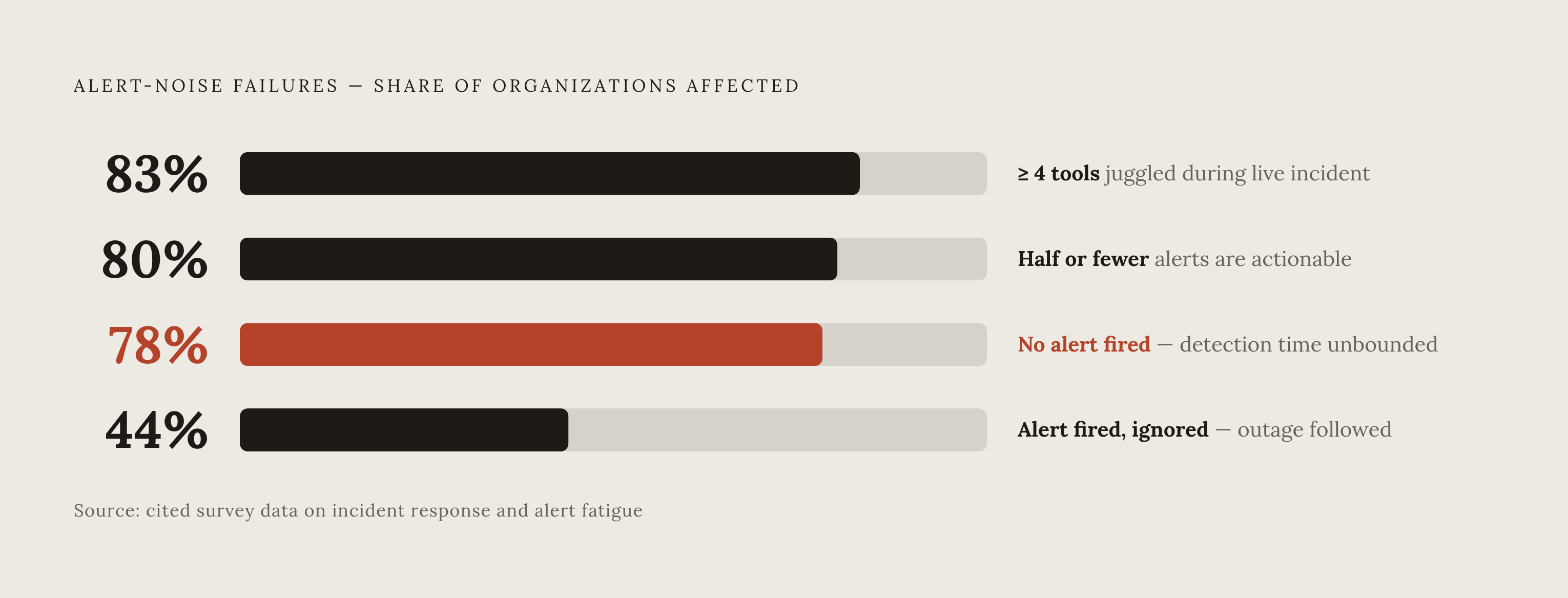
Good observability can cut Mean Time to Resolution by 50 to 70% https://vettedoutsource.com/blog/devops-monitoring-observability/. For most teams, it doesn't, because the alerting layer is broken in a specific, measurable way. Survey data drawn from a large pool of SRE, DevOps, and IT operations professionals found that 80% of organizations say half or fewer of their alerts are actually actionable, and 77% of on-call teams field at least ten alerts a day https://neubird.ai/resources/cut-alert-noise-90-percent-on-call-teams. That's a substantial structural failure, not a minor tuning issue, and it's bad enough to erase most of the architectural work a team has done to hit its RTO targets.
The downstream consequences run worse than fatigue. 78% of organizations have had incidents where no alert fired at all, meaning Detection_Time in those cases wasn't just slow, it was unbounded https://neubird.ai/blog/lifeline-for-teams-drowning-in-alerts. 44% had outages tied to alerts that fired but got ignored or suppressed, which is what happens once noise has already taught engineers to distrust the pager https://neubird.ai/blog/lifeline-for-teams-drowning-in-alerts. And 83% of organizations are juggling four or more separate tools during a live incident. Every extra tab an on-call engineer opens mid-outage is time the SLO clock keeps running regardless of who's looking at what https://neubird.ai/blog/lifeline-for-teams-drowning-in-alerts. Engineers report burning around 40% of their time on incident management instead of building anything, and toil, after five straight years of decline, ticked back up to 30% in 2025 from 25% the year before https://neubird.ai/blog/lifeline-for-teams-drowning-in-alerts https://runframe.io/blog/state-of-incident-management-2025.
Google's own benchmark for on-call load sets a ceiling of no more than two pages per twelve-hour shift, and most teams operating today are nowhere near that number https://www.em-tools.io/engineering-metrics/on-call-load. One documented case cuts against the gloom: an engineering team brought its alert volume down by more than 60% over four months and, in the process, flipped its work split from roughly 60/40 between product development and operational toil to something closer to 85/15 https://neubird.ai/blog/lifeline-for-teams-drowning-in-alerts. The fix followed a specific order, and that order deserves to be taken seriously. Deduplicate first, then group and correlate related alerts, then layer in dependency-aware suppression, then move toward SLO-aligned thresholds, and only after all of that, fix the instrumentation at the source. Downstream filtering buys fast relief, but it drifts back toward noise within a few months. Source-level instrumentation is the only lever that produces a reduction that actually holds.
AI-generated code at agent speed is compressing the time teams have to catch failures
Gartner projects that 40% of enterprise applications will embed task-specific AI agents by the end of 2026, up from less than 5% in 2025 https://www.strata.io/blog/agentic-identity/agentic-ai-governance-how-to-approach-it/. Enterprises are deploying these agents faster than they're building oversight for them: agents are already touching customer data, calling internal APIs, and chaining actions across cloud environments with very little human review of any single step along the way.
The reliability risk here isn't the same risk as a bad code deploy, and treating it as though it were understates it badly. AI agents act autonomously and touch other systems directly, so an error doesn't sit still waiting to be noticed. It propagates, compounds, and amplifies across multi-agent interactions in ways considerably harder to detect and harder to roll back than a traditional software bug. Worse, the failure often doesn't resemble a failure. An agent can return a 200 OK while producing a wrong answer, burning through its token budget, or quietly drifting off the task it was given, and traditional application monitoring, built to watch for errors and downtime, has no way to catch any of it. That's a new category of blind spot sitting directly inside Detection_Time, arriving faster than most observability stacks are being redesigned to handle it.
Treating RTO and RPO as pipeline design requirements going forward
RTO and RPO are not numbers a team negotiates once during an SLA conversation and files away. They are constraints that belong in every deployment decision, every rollback strategy, and every dollar spent on observability, from here forward.
Mapped against the RTO formula, that turns into concrete engineering work rather than a policy statement. Reducing Detection_Time means gating deployments on observability health checks, automating smoke verification against real telemetry the moment a deploy lands, and instrumenting every service before it ships rather than after an incident exposes the gap. Cutting Decision_Time means writing the rollback contract before the incident happens, tied to specific commit SHAs and a named last-known-good artifact, with failure signals and ownership documented in advance instead of argued out in a war room under pressure. Cutting Restoration_Time means paying for automated failover and pre-provisioned standby capacity before it's needed, not after the outage that proves it was needed.
None of this removes the exposure that comes with shipping fast, and no amount of tooling makes that exposure disappear. But it moves RTO and RPO out of the binder nobody reads and into the pipeline itself, where they can do the job they were designed to do. The cost of getting this wrong is not abstract: 96% of organizations report downtime costs exceeding $100,000 per hour, and roughly one in six significant outages, 16%, cost more than $1 million https://www.ittoolkit.com/rto-vs-rpo-complete-guide-to-recovery-objectives-2025/ https://www.traversal.com/blog/ai-in-incident-response-state-of-the-field-2026-sre. With 51% of organizations already running AI initiatives in production and 86% expecting to deploy AI by 2027, the volume of autonomous, hard-to-detect failure moving through these pipelines is only going to grow https://runframe.io/blog/state-of-incident-management-2025.