Defining Error Budgets That Product Managers Will Actually Use
Make error budgets visible to product managers so they actually guide release decisions.

Error budgets fail most often for a reason that has nothing to do with the underlying math. They fail because they get defined entirely in engineering terms, on an engineering dashboard, in engineering language, and product managers never open the tab. The tension driving this is structural: product wants to ship weekly, SRE wants the system to hold together, and without a number both sides trust, the debate over any given release turns into a matter of opinion and seniority. Google's SRE book built the error budget precisely to close that gap, giving both sides a common, data-driven way to weigh launch risk. Instead, in most organizations, the budget sits untouched on an SRE dashboard, consulted by exactly the team that already agrees on the risk tolerance, while the team that actually decides what ships never sees it. The rest of this piece is about how to move that number off the dashboard and into the sprint room.
The three-layer model, and why PMs only need the top layer
The stack underneath an error budget has three layers, and a PM only needs to care about the top one. Service Level Indicators measure the raw signals: availability, latency, error rate. Service Level Objectives set the target against those signals. The error budget is what falls out once you subtract the target from perfection: it's the allowable amount of failure over a given window, expressed as a number a team can spend. For a product manager, the SLI is plumbing. What matters is the budget itself, because it answers one question directly: how much room is left before reliability work has to bump features off the roadmap.
Google's own operating rule makes that translation concrete. As long as a service hasn't burned through its error budget via background errors plus downtime, engineering keeps shipping. Once the budget is spent, changes freeze, with an exception carved out for urgent security patches and bug fixes, until the team earns room back or the window resets. For services running at very high reliability targets, Google recommends resetting that window quarterly rather than monthly, since the absolute amount of downtime allowed is so small that a monthly cycle manufactures urgency that isn't real. One more distinction matters here: the budget should be pegged to the SLO, not to the customer-facing SLA. Tying it to the SLA instead makes teams defensive and conservative, and it strips the budget of the operational flexibility it was built to provide.
Translating the budget into release-decision language a PM can use in a sprint
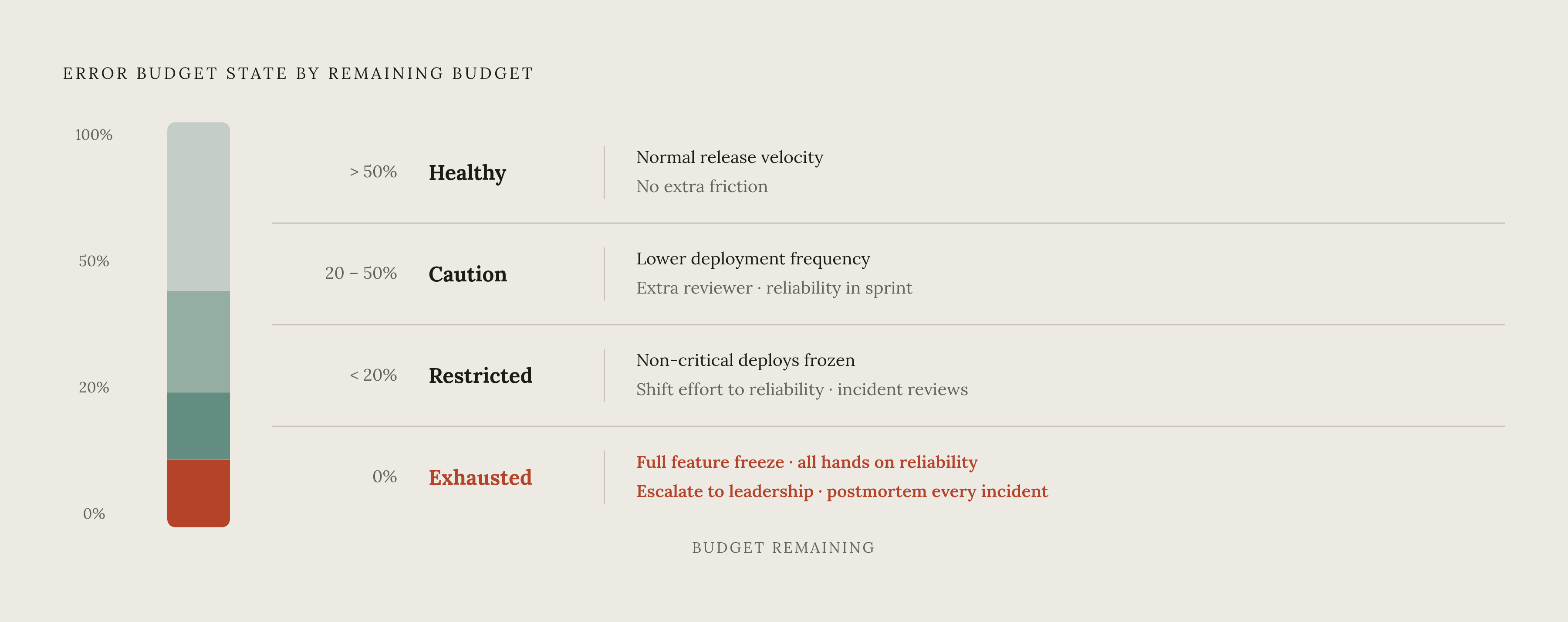
A number on a chart doesn't change anyone's behavior. An error budget only starts influencing decisions once it's wired into release rules that both sides agreed to ahead of time. The clearest way to do that is a four-state model that maps the budget to four named operational states, each with a defined release posture.
Healthy means more than half the budget remains: ship at normal velocity, no extra friction. Caution kicks in somewhere between a fifth and half remaining: deployment frequency drops, risky changes need an extra reviewer, and reliability work gets a line in sprint planning instead of getting deferred. Restricted starts below a fifth, before the budget hits zero: non-critical feature deploys freeze, engineering effort shifts toward reliability, and any recent outage gets a formal incident review. Exhausted means zero budget left, triggering a full feature freeze, all hands on reliability, an escalation to leadership for resourcing, and a postmortem for every incident that burned the budget down.
The mechanism that makes this durable, rather than aspirational, is automation. CI/CD pipelines can block non-critical deploys automatically once the budget hits zero, so the policy holds without anyone having to say no out loud in a meeting where saying no is unpopular. Under this model, the PM's job is not to understand the SLI, but to know which state the service is in and what that state means for the roadmap.
Burn rate: the signal that creates urgency before the budget runs out
Remaining budget tells a team where it stands. It says nothing about where it's heading. Burn rate is the leading indicator: it shows a team drifting toward a policy change before the threshold gets crossed, giving both sides time to react instead of finding out after the freeze is already in effect.
A slow burn justifies a low-priority ticket and a conversation at the next sprint planning session, nothing more urgent than that. A fast burn justifies a high-priority alert and an immediate look at whatever shipped recently. A very fast burn justifies paging on-call right away, because the system is failing faster than it can recover inside the current window. SLO burn-rate alerts should replace the raw infrastructure alerts, CPU spikes, memory warnings, queue depth, that fire on conditions rather than on anything a user actually experiences, and alert design should change accordingly. Alert fatigue is a tooling problem: paging on infrastructure metrics instead of budget consumption manufactures noise, and that noise erodes trust in both the pager and the budget system behind it.
This is precisely the gap that automated post-deploy verification is built to close. A system that watches production telemetry after every deploy and flags when burn rate accelerates, rather than waiting for someone to notice a dashboard trending the wrong way, turns burn rate from a metric someone has to remember to check into a signal that reaches the right person automatically, at the moment it starts to matter.
Setting SLO targets that reflect what users actually experience
An error budget is only as trustworthy as the SLO it's built on. Building the SLO around the wrong signal gives product the wrong release signal, and people stop trusting the budget the first time it reads "healthy" during a week users were visibly unhappy. Google's own guidance on this is direct: define SLOs around what users actually care about, not around whatever happens to be easiest to instrument. Starting from convenience produces SLOs that look precise and mean very little.
Getting this right takes real engagement with what users expect instead of a default to uptime because uptime is the easiest thing to graph. Tail latency and error rates on the paths users actually rely on tend to matter more to the people experiencing the product than an aggregate availability number ever will. Sedai's guidance points at the other failure mode: SLOs set too aggressively, without grounding in historical performance data, produce constant violations, and constant violations teach everyone on the team to stop paying attention to the budget. Consider an online retail platform holding to a 99.9% uptime commitment through its peak holiday shopping season: the SLO has to be realistic enough to survive the highest-traffic, highest-stakes weeks of the year, or it becomes meaningless the one time it's actually tested. And the SLO itself needs daylight between it and the SLA. That gap is what gives a team room to notice a problem and respond before a contractual obligation is actually at risk.
Telemetry gaps that make the error budget lie to everyone
Even a well-chosen SLO produces a dishonest budget if the telemetry feeding it has holes. Missing telemetry doesn't just create observability blind spots, it systematically undercounts failures, which makes the budget look healthier than the system actually is. That's the worst possible failure mode for a tool whose entire job is to tell product when it's safe to ship.
Most root-cause analysis techniques assume every service in a call path emits a full trace, and in real production microservice environments, that assumption breaks down constantly. A 2024 review of multi-service architectures traced a substantial share of these gaps to trace context getting dropped or transformed as calls cross service boundaries, and set a practical benchmark: a strong majority of services in a given architecture need to emit traces with standard context propagation fields before the tracing data can be trusted. When a service sits outside that instrumented majority, its failures never register in the SLI at all, so the error budget doesn't burn when it should, and the gap is invisible to everyone relying on the number. OpenTelemetry has become the common baseline teams use to close that gap across otherwise inconsistent stacks, giving heterogeneous services a shared format for trace data instead of each one inventing its own.
None of this gets caught in CI. A deploy can pass every pre-production check and still open a blind spot the error budget has no way to see, because production telemetry, not a green CI pipeline, is the only ground truth that actually reflects what users experience. Automated verification that checks real post-deploy telemetry against every pull request, rather than relying on pre-production tests alone, closes exactly this gap between what CI confirms and what's actually true once code is live.
Agentic development raises the stakes for every concept covered so far
Every weakness described so far gets worse once code starts shipping at agent speed. LangChain's State of Agent Engineering report found that a majority of organizations already run agents in production, and a large share of those same organizations name quality as their top barrier, yet almost none of them have a framework for deciding how much agent failure is tolerable. That's an error budget problem without an error budget attached to it.
Agents raise the stakes because they act autonomously and touch other systems directly, and a 2026 arxiv paper on the subject makes the risk explicit: both outright agent failures and agents that technically succeed while executing the wrong objective can cause more damage than a non-agentic system would, simply because there are fewer human checkpoints where someone could catch the problem before it spreads. A separate arxiv paper from February 2026, testing models across standard benchmarks, found something that should worry anyone building release policy around accuracy scores alone: accuracy improved steadily, but reliability improved only modestly. A model can get more answers right on average while growing less consistent from run to run. That means SLOs written purely around accuracy miss the risk. Consistency and predictability need their own targets instead of a footnote under an accuracy number.
Regulators are already responding to this gap. The NIST AI Risk Management Framework, updated in 2025, added specific guidance for agentic systems and recommends circuit breakers that cut off an agent's access automatically once it crosses a defined threshold, which is structurally the same idea as an error budget policy enforced at the CI/CD layer. Generating reliable software with agentic tools still requires deliberate practice and active human supervision, since output quality depends heavily on the prompts, the skills built into the workflow, and how a human responds when the agent gets something wrong. Put together, these findings point in one direction: automated error budget enforcement in the deployment pipeline stops being a nice-to-have once agents are shipping code, because it's one of the few safeguards left standing when the volume of change outpaces the humans available to review it.
Making the error budget review a standing conversation between product and engineering
Every practice covered so far, the four-state policy, burn-rate alerting, honest SLOs, clean telemetry, automated enforcement for agentic pipelines, degrades into background noise without one more thing: a standing meeting where product and engineering look at the same number together and decide something. Neel Shah's analysis distinguishes error budgets that work from ones that don't. Error budgets work when teams treat them as decision frameworks, answering "should we deploy this?", rather than as a metric that only answers "how are we doing?". Shah identifies three practices that separate teams where this actually functions: burn-rate alerting that creates urgency ahead of exhaustion, a policy that defines real consequences, and a regular review that ties the reliability data back to what engineering is actually prioritizing.
The review's cadence should mirror the budget's own window: monthly reviews for a monthly budget, quarterly for the quarterly reset Google recommends on high-SLO services. In that meeting, the PM brings roadmap risk to the table, which upcoming releases are big enough bets to justify spending budget on, and which can wait a sprint or two. The SRE brings the current burn trajectory. Neither side is negotiating who owns reliability. Both are looking at the same chart and making a release call from it.
Skipping this rhythm doesn't make the coordination cost disappear, it lands on-call. Teams that haven't automated burn-rate alerting and policy enforcement end up with on-call engineers absorbing work the tooling should be handling; LogicMonitor's SRE Report 2026, produced with Catchpoint, found that toil already consumes a median of 34% of engineers' time. Piling manual coordination on top of that wears down both the rotation and the working relationship with product over time. Sherlocks.ai's 2026 incident response analysis points at the same failure in a different place: most of the delay in incident response sits in investigation, not detection, and an automated response that opens a fix PR the moment a policy threshold is crossed shortens that gap without anyone needing to spin up a war-room Slack thread.
None of this makes the error budget an SRE enforcement mechanism aimed at product. It's the shared currency that lets both sides talk about risk in the same units, a PM and an SRE looking at the same burn-rate chart and agreeing, together, on what ships next.