Evaluating Post-Deploy Verification Platforms for High-Frequency Release Teams
Separate observability from verification to catch regressions that dashboards miss.

Observability and post-deploy verification answer two different questions, and confusing them is the first mistake teams make when evaluating tools in this category. Observability asks what the system is doing right now. Post-deploy verification asks something narrower and more urgent: did this specific deploy cause harm, and is the evidence confirming that fresh enough to act on? It does not tell you whether the metrics tied to a deploy that shipped eleven minutes ago are within acceptable range of the baseline that deploy replaced. That gap, between telemetry existing and telemetry being checked against a specific change, is where verification lives as its own discipline.
Without traces, logs, and metrics actually being collected, nothing downstream works, and no verification platform can check what isn't being measured. But a verification gate has to do something a dashboard doesn't. It has to confirm, on a schedule tied to the deploy itself, that this release's behavior holds up against what came before it. Tools like OnePatch occupy exactly that junction, between a pull request and production: they confirm not just that code shipped, but that the signals needed to trust it are flowing and healthy relative to the pre-deploy baseline.
What makes this concrete rather than philosophical is the shape of the evidence a verification platform has to produce. A trustworthy result carries a deployment SHA and image identity, a timestamp for when the observation happened, the criterion being tested, the threshold that criterion had to clear, the result itself, and an honest account of what the check did and didn't cover. A probe that ran successfully is not the same claim as an application that is healthy. Evaluating a platform in this category starts with asking whether it understands that distinction structurally, not just as a UI convention.
How high-frequency release cadences expose failure modes that dashboards cannot catch
Deploy frequency has outrun the human review cycle. Teams are shipping at a rate where manual review was never going to keep up in the first place, not choosing to skip it out of carelessness.
The danger compounds with velocity. When deploys happen several times a day instead of once a week, an undetected regression doesn't sit still waiting to be found. A failure can be entangled with three or four releases at once by the time it surfaces, and untangling which change actually caused the problem becomes its own investigation. This is a structural property of high-frequency shipping, not a question of whether any individual team is disciplined about testing.
AI-generated code adds a failure mode that neither CI nor a static dashboard is built to catch: behavioral drift. Nothing about the infrastructure looks unhealthy, because nothing about the infrastructure is unhealthy. Automated post-deploy verification platforms, OnePatch among them, exist to catch exactly this kind of regression, by checking every PR against live production telemetry after it ships rather than depending on a review cycle that was never built to move at agent speed.
The cost of that gap doesn't disappear. None of that is incident response in the traditional sense. It's the unpaid labor of verification that should have happened automatically before anyone got paged.
Verification fan-out under load: why orchestration design is the first evaluation criterion
The first thing to check in any post-deploy verification platform is whether its own process can take production down. A platform that launches every verification workflow at once against a production runtime that has finite capacity isn't just running checks, it's generating load, and unmanaged load against a constrained system produces the same symptoms as a traffic spike: timeouts, restarts, and failed health checks that have nothing to do with the code that was deployed.
A documented production failure makes the mechanism plain. On a single-instance service, immediately after a successful deploy, several workflow consumers hit the runtime at the same moment: spread-forward shadow, spread-forward canaries, certification replay, and prop-evidence workflows, all triggered off the same deploy-completion signal. Routes started returning 499s and 502s, uvicorn restarted, and the health endpoint came back with a 503. None of that reflected a problem with the deployed code. It reflected a verification process that behaved like an uncoordinated traffic surge. The deploy was healthy. The verification process was the incident.
This is why fan-out orchestration has to be the first question asked when evaluating a platform, ahead of how sophisticated its regression detection is. Does it sequence heavy post-deploy probes? Does it let a team set concurrency limits per workflow? And when it does serialize checks to protect the runtime, does it still record a skipped probe as unverified, rather than letting a sequencing decision quietly count as a pass? A platform that manages concurrency and preserves that fail-closed behavior even under constrained sequencing is one a high-frequency team can trust with production traffic. One that doesn't is a liability wearing a verification badge.
The better pattern looks like durable, scheduled checkpoints rather than a single fan-out storm triggered at deploy completion. Any platform worth trusting treats the verification process itself as a load event that needs managing, rather than assuming production can shrug off whatever volume of checks get thrown at it.
Telemetry-backed regression detection: what separates a verification signal from an alert
Once a platform can run its checks without taking the runtime down, the next question is what those checks actually compare. The comparison that matters is post-deploy telemetry against a pre-deploy baseline anchored to the specific deployment SHA that just shipped. A rolling average won't tell you that this deploy made things worse, it'll just blend the regression into a wider window. A static threshold carries no information about whether the deploy happened. Comparing against yesterday's metrics is risky in a more specific way: yesterday might already reflect a regression from the deploy before this one, and the baseline itself is compromised before the comparison even starts.
Three telemetry signals do different jobs here, and a platform that leans on only one of them is working with a narrower view than it should. A platform that treats metrics as the whole story leaves traces and logs, the two signals best suited to explaining why a metric moved, out of the verification loop.
What turns a telemetry observation into an actual verdict is a pass/fail line, and that's what error budgets and SLOs provide. If a release burns through its error budget faster than the agreed burn rate, it fails the check. That's a different kind of statement than an alert. An alert says something looks off and someone should look at it. A hunch and a decision a pipeline can act on automatically are not the same thing, and a verification result is the latter.
Evaluating a platform on this criterion means asking a short list of specific questions. Does it anchor its comparison to the deploy SHA, rather than to a time window that might span several deploys? And does it support checking behavioral correctness, not just infrastructure uptime, which matters enormously once agent-produced code and agent-produced outputs are part of what's shipping.
Automated recovery: why the right response to a detected regression is a fix PR, not a war room
Catching a regression is only half the job. If detection just hands an engineer a dashboard and a summary, the toil hasn't gone away, it's moved. Instead of hunting for the problem, the engineer is now triaging it: opening an incident channel, pulling in whoever owns the affected service, and coordinating a response across tools that don't talk to each other. That's still hours of work, just relabeled.
A copilot and an agentic system are distinct. A copilot surfaces a summary and leaves the engineer to go figure out what it means. An agentic system does the analysis end to end: it walks the dependency graph, returns a root cause backed by actual evidence rather than a correlation, and opens a fix PR that a human can review and approve or reject. A detected regression turns into twenty minutes of review when the dependency graph and root cause are already surfaced, or three hours of investigation when they aren't.
The direction the category is heading is toward systems that start working the instant an alert fires, analyzing telemetry and narrowing in on a root cause before a human has even opened a dashboard. The line separating real analysis from "AI washing" is whether the system investigates the problem or just correlates signals that happen to look related. Investigation means tracing a failure back through the dependency graph to a specific cause. Correlation means noticing that two things happened around the same time and calling that an answer.
There's a cost to manual response that compounds with every additional tool an engineer has to open during an active incident: each one is time the SLO keeps burning while the person chases down context across systems that weren't built to share it. A platform that folds verification, root-cause analysis, and fix initiation into a single workflow cuts that cost in a structural way, not just a more convenient one. This is the second natural point where OnePatch fits the pattern: it checks every PR against live production telemetry after it ships, catches regressions before they escalate into a page, and opens fix PRs for human review, keeping the response inside the code review workflow a team already uses. The question to ask of any platform in this category is simple. When it detects a regression, does it open a fix PR, or does it page a human and stop there?
How agentic development pipelines raise the verification bar further
Everything above assumes a baseline level of upstream oversight, a human who wrote the code or at least reviewed it before it shipped. That assumption stops holding once agents are writing and shipping code themselves, and when it stops holding, the verification platform has to pick up the slack that used to sit with a reviewer.
Running agent-produced code safely in production means being able to answer a few specific questions about it. Can an action be traced back to a specific agent version through cryptographic identity? Is the tool access that agent has scoped tightly enough to verify after the fact what it was actually allowed to touch? And is there a way to check its runtime behavior against known-good criteria, not just whether the infrastructure it runs on stayed up? These are the minimum needed to hold an agent accountable for what it does once the usual human-in-the-loop review has been removed from the pipeline.
The governance landscape hasn't caught up to this yet. Post-deploy verification is one of the few controls a team can apply today against those risks, because it doesn't depend on the governance frameworks catching up first.
Evaluating a platform for agent-deployed code means asking whether it checks behavioral correctness and not just infrastructure health, whether it keeps per-agent-version telemetry so that a model update gets treated as its own versioned deploy event rather than an invisible change, and whether it produces an audit trail detailed enough to support accountability after something goes wrong.
What a complete evaluation framework looks like in practice
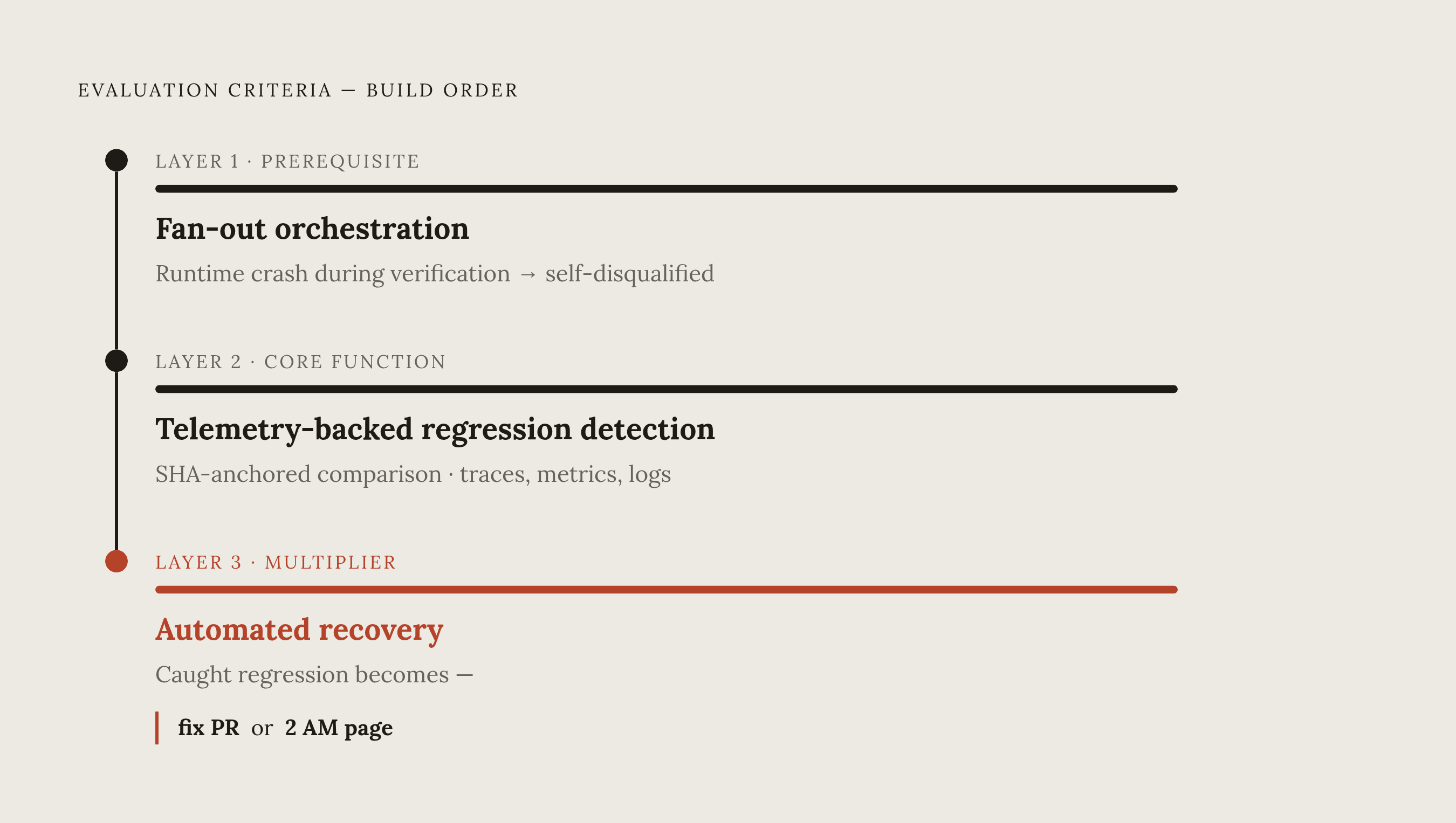
The three criteria this piece has walked through aren't a flat checklist, they build on each other. Fan-out orchestration is the prerequisite: a platform whose own verification process can crash the runtime has disqualified itself before regression detection even enters the conversation. Telemetry-backed regression detection is the core function, the part actually doing the work of deciding whether a deploy is healthy. Automated recovery is the multiplier: it turns a caught regression into either a quiet fix or a 2 AM page with a Slack thread attached.
On fan-out, the questions are concrete: does the platform sequence heavy post-deploy probes instead of firing them concurrently, does it preserve fail-closed semantics when it serializes checks, and does it manage fan-out across workflows and not just within a single one? On regression detection: is the comparison anchored to the deploy SHA, does it draw on traces, metrics, and logs together rather than metrics alone, and does it distinguish a probe that ran from an application that's actually healthy? On recovery: does the system investigate a failure or just correlate signals that happened at the same time, and when it finds a regression, does it open a fix PR or stop at a page?
OnePatch answers this framework directly. It sits between pull requests and the live production environment, checking every PR against real telemetry once it deploys, catching regressions before they require a human to get paged, and opening fix PRs for review, keeping the response inside the code review workflow a team already uses. It's a description of a platform built around the same three criteria a high-frequency release team should be applying to anything it evaluates here, among other options in this category.
One more detail belongs in the evaluation: how the platform is priced. A vendor charging per incident resolved has an incentive aligned with the outcome the engineering team actually wants, fewer incidents, not a vendor whose revenue grows with seat count regardless of whether anything actually gets fixed. That's a small detail next to fan-out design and SHA-anchored regression detection, but it's the kind of detail that tells you whether a vendor's business model agrees with the problem it claims to solve.